
What to Wear in 70 Degree Weather: Fall vs Spring Outfits
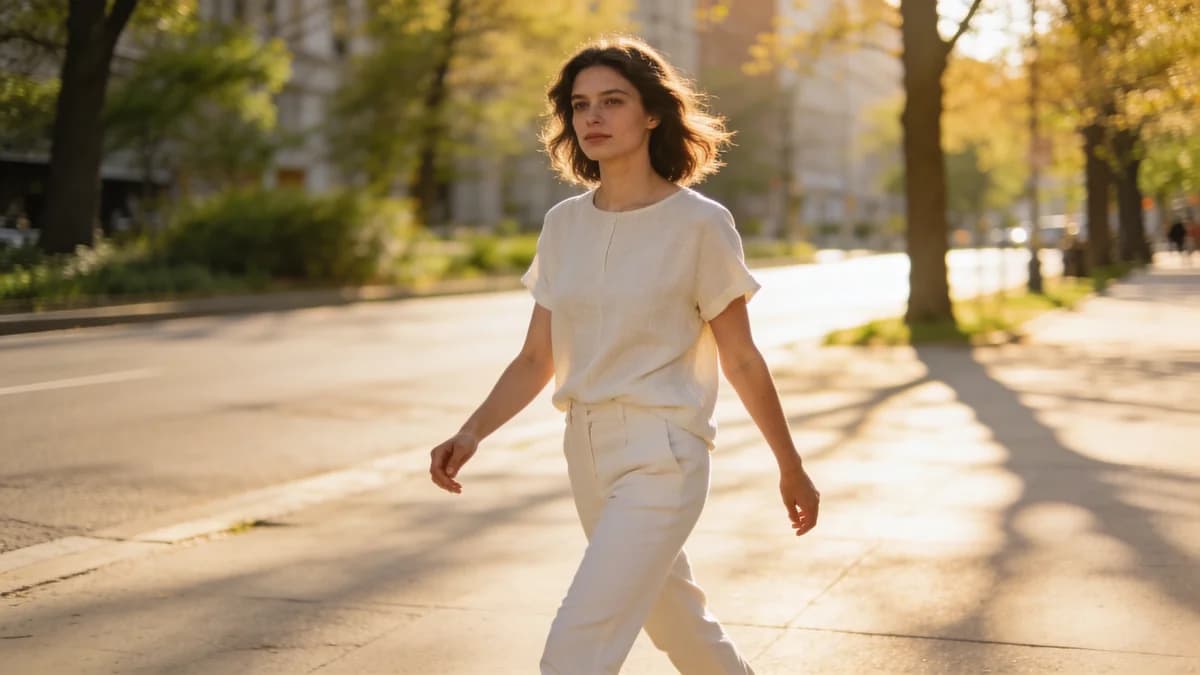
In 70 degree weather, wear one breathable layer, carry a light jacket or cardigan, and pick one shoe that works from a cool morning to a warm afternoon. The season changes which end of the day you're dressing for: a fall 70 turns cold fast after sunset, while a spring 70 starts cold and ends mild.
Below: fall vs spring side by side, outfits for work, weekends, date night and outdoor plans, the shorts question answered properly, and the fabrics that hold up.
What to Wear in 70 Degree Weather: One Layer, One Backup, One Shoe
Three decisions, and the rest of the day takes care of itself.
Wear one breathable layer you'd be happy in all day, carry a second light layer you probably won't put on until evening, and pick a shoe that handles a cool morning and a warm afternoon without a swap. At 70°F (21°C) most people are comfortable in a single layer, which is exactly why this temperature catches people out. Noon is easy. Everything before nine and after six is the part that needs planning.
One Layer is the piece you'll be seen in. It has to stand on its own, because for six or seven hours nothing will be over it. That rules out the shirt you only wear open across a tee, and it rules out the thin tank you'd normally keep under a cardigan.
One Backup is the jacket, cardigan, or overshirt that lives on your arm, in your tote, or over the back of a chair. At 60 degrees you wear the jacket. At 70 you carry it. That one shift is the entire difference between the two temperatures, and it's why 60 degree weather outfits look overbuilt when you copy them straight onto a 70 degree day.
One Shoe means choosing footwear you won't want to change at lunch. Sandals are right at two in the afternoon and wrong at eight in the morning. A closed shoe with a thin sock covers both ends of the day, which is why loafers and low sneakers do so much work in this range.
The rule: One Layer, One Backup, One Shoe. Get the backup into your bag and the day forgives almost everything else.
70 Degrees in Fall vs Spring
Same number on the phone, two completely different days.
Most temperature guides treat 70 as a single condition. It isn't. Seventy degrees in late September is the tail of summer heat cooling off, and 70 degrees in April is the top of a cold week climbing up. The thermometer agrees with itself. Your body doesn't.
| What you're deciding | 70 degrees in fall | 70 degrees in spring |
|---|---|---|
| The morning | Starts close to the day's high, warm by breakfast | Starts well below it, the day has to climb |
| What changes through the day | Warms early, then drops quickly after sunset | Cold first, peaks late afternoon, mild evening |
| Backup layer | Knit cardigan, shirt jacket, light leather | Denim jacket, light trench, unlined blazer |
| Shoe | Loafers, ankle boots, leather sneakers | Canvas sneakers, ballet flats, sandals after noon |
| Color instinct | Olive, rust, tobacco, cream | Pale blue, white, stripe, washed denim |
Fall is the easier of the two to dress for, because the day starts near its high and slides from there. Light wool or cotton trousers, a long-sleeve shirt with the sleeves pushed up, loafers over a no-show sock, and a shirt jacket carried out of the house rather than worn. In September and October the palette does more work than the fabric weight. Olive, rust, tobacco brown and cream read as autumn without adding a single degree of warmth, which is how you get a genuine fall outfit out of summer-weight clothes. Our fall outfit ideas go further on that, but the short version is to keep the fabric light and change the color.
The backup layer is where a fall 70 differs most. Once the sun goes down in October the drop is quick and it keeps going, so what you carry needs more substance than the spring version. A cardigan in a real knit, a corduroy overshirt, or a light leather jacket all handle a warm afternoon turning into a cold walk back to the car. In April, denim would have been enough.
Spring runs backwards. You leave in the coldest part of the day and come home in the warmest, so the jacket goes on first, comes off around ten, and never returns. Crisper fabrics suit it, partly because spring 70 tends to arrive with more wind than fall 70 does, and lighter colors make more sense against bare trees than against turning ones. Spring outfit ideas handles the palette side of that.
Season rule: In fall you dress for the evening. In spring you dress for the morning. Same 70 degrees, opposite ends of the day.
Building the One Layer
The piece that has to work with nothing over it.
A short-sleeve cotton tee is the default here and there's nothing wrong with it, as long as it fits at the shoulder and doesn't go translucent in direct sun. A linen or cotton-linen shirt does more for the same comfort. It breathes better, the rolled sleeve gives you a second version of the same garment, and it moves from a desk to a dinner without a change of clothes.
If you want the dressier end of 70 degree outfit ideas, a light button-down, a fine-gauge polo, or a cotton shell top will carry a full day on their own. Dresses are the single-garment version of the same principle. A cotton poplin midi, a shirt dress, or a light knit dress solves the whole outfit at once, which is why they come up constantly in 70 degree weather outfit women searches. For men, a linen-blend shirt over chinos is the most reliable single answer in the temperature range.
Bottoms deserve more thought than they get, because they're the half of the outfit that doesn't get adjusted later. Lighter-weight straight-leg jeans, chinos, cotton trousers, and anything with a wider leg all move air well enough. Heavy raw denim is the one to skip, since it traps heat around the legs and you can't do anything about it once you're out.
Sleeve length is the quiet decision. Long sleeves you can push up beat short sleeves here more often than people expect, because they give you two settings instead of one.
The Backup You Carry, Not Wear
Insurance for the two hours the forecast doesn't describe.
| Backup layer | Works best for | How you carry it |
|---|---|---|
| Denim jacket | Spring weekends, casual evenings | Over the shoulder or tied at the waist |
| Shirt jacket or overshirt | Fall commutes, offices, outdoor dinners | Worn open on the way out, off by ten |
| Fine-knit cardigan | Restaurants, meetings, flights | Folds flat into any tote |
| Unstructured linen blazer | Work, dinner, anywhere with a dress code | Over the arm, and rumpled is the point |
| Cotton hoodie | Errands, kids' sports, evening walks | Around the waist or left in the car |
| Packable windbreaker | Trails, the coast, anywhere exposed | Compresses into its own pocket |
The mistake isn't choosing the wrong backup, it's not bringing one at all and then spending the evening with your arms crossed. The second mistake is bringing something you have to protect. If the layer can't be crushed into a bag or tied around your waist, you'll leave it somewhere.
Air conditioning is the other reason to carry something even on the warmest 70 degree day. Plenty of buildings run cold enough in September that the cardigan you packed for the evening earns its place by eleven.
Pro tip: pick the backup that survives being crushed. A blazer you have to hang up isn't a backup layer, it's a third thing to keep track of.
70 Degree Outfit Ideas by Occasion
Four kinds of day, four different answers.
Work and Office
Seventy degrees is the first temperature all year where your commute needs no outerwear at all, which means the outfit has to look finished on its own. Trousers or a midi skirt with a cotton or linen shirt, loafers or flats, and an unstructured blazer over your arm covers almost every office. For men, chinos with a button-down and the sleeves rolled, leather loafers, and a cotton blazer only if there's a meeting.
Check the building, not the weather. Our guide to work and office outfits covers the dress-code side once the temperature is settled.
Saturday, Hour by Hour
- Eight in the morning, coffee run. Jeans, a long-sleeve tee, low sneakers, and the hoodie or denim jacket you'll have off within the hour.
- Eleven, errands. Sleeves pushed up, jacket around the waist or in the car. This is the stretch where the single layer does everything.
- Two, lunch outside. The sun makes 70 feel closer to 75. Nobody who wore shorts regrets it at this point in the day.
- Seven, dinner somewhere with a patio. Backup layer on before you sit down, because sitting still outdoors feels several degrees cooler than walking did.
One swap moves the same base outfit between all four. Sneakers to loafers, or tee to button-down, and it reads differently without changing anything else, which is the approach our everyday casual outfit guide is built around.
Date Night
This is the best temperature of the year for it, and the reason is simple: nothing is hidden. No coat to check, no bulk to work around, no arriving wind-blown. Every choice you made is visible, so the fit of the one layer matters more than usual.
A slip skirt or midi dress with a fitted top, strappy sandals or heeled mules, and a cardigan for the restaurant covers it. For a 70 degree date night outfit on the men's side, dark slim jeans or lightweight chinos, a quality button-down with the top button open, and leather loafers. Skip the jacket unless you already know the place runs cold, and if you're unsure, bring the one that folds.
Outdoor and Active
- Running or cycling: dress as though it's ten to fifteen degrees warmer than it is, because you'll generate the difference within a mile. Short sleeves or a tank, shorts, and nothing you'll have to carry.
- Hiking: a moisture-wicking tee, trail shoes, and a packable windbreaker in the pack for exposed stretches. Sun protection matters more than warmth on a clear 70 degree trail.
- Spectating or picnicking: sitting still outdoors is a different temperature than walking outdoors. Bring the layer even if you didn't need it on the way over.
- Golf: 70 degrees is close to ideal, and the course has its own rules about collars and fabrics that the weather doesn't override. Our golf outfit guide covers what passes where.
Morning to Evening on a 70 Degree Day
Where the outfit gets tested, and usually where it fails.
A day that peaks at 70 doesn't sit there. It climbs into that number in the morning and falls back out of it after sunset, and the gap between the coolest and warmest hours is wide enough that a single unlayered outfit will feel wrong at one end or the other. That's the whole argument for One Layer, One Backup, One Shoe.
The sequence is short. Jacket on for the commute, jacket off by midmorning and stowed somewhere you won't forget it, jacket back on when you step outside after dark. In spring, step three often doesn't happen. In fall, it always does.
Sitting still is the variable nobody accounts for. Seventy degrees while you're walking is comfortable in short sleeves; the same 70 degrees on a patio chair for two hours is not. Shade does something similar, which is why the same outfit can feel entirely different depending on which side of the street you're on. Figuring out whether one outfit survives all of that is easier to see than to imagine, which is where a planner like Klodsy's daily outfit tool is genuinely useful.
If your mornings are still starting far below the afternoon high, the layering logic in 50 degree weather outfits covers the first two hours better than anything here does.
Is 70 Degrees Warm Enough for Shorts?
Yes, with three variables that can flip the answer.
Yes. Seventy degrees is comfortably within shorts range for most people during daylight, and it's the point where most people switch over without thinking about it. The three things that change the answer are sun, wind, and how still you're going to be.
Sun is the big one. Seventy degrees in direct afternoon sun feels meaningfully warmer than 70 in shade, and if your plans are outdoors and exposed, shorts are the obvious call. Wind runs the other direction. A breezy 70 degree day on open ground feels cooler on bare legs than the number suggests, and lightweight trousers will keep you comfortable for longer. Activity settles the rest. Walking, cycling, and anything with effort behind it makes shorts feel necessary; sitting at an outdoor table for two hours makes them feel optimistic.
Which shorts depends on where you're going. Chino shorts with a seven to nine inch inseam handle brunch, errands, and casual dinners without looking like gym wear. Tailored linen shorts work on humid days and dress up further than people expect. Athletic shorts belong with athletic plans. Denim shorts are the weekend default and the one pair that survives everything.
The fall version of this question has a different answer. A 70 degree day in October reads as warm relative to the week around it, but the evening arrives early and cold, so shorts that were right at two can be uncomfortable by six. That's the day to wear light trousers instead and keep the comfort for the whole stretch.
Bottom line: sun and movement say shorts. Wind, shade, and sitting still say lightweight trousers. The thermometer alone decides nothing.
Best Fabrics for 70 Degree Weather
Breathability wins here; insulation has nothing to do.
At this temperature you're wearing one garment for most of the day, so that garment has to handle airflow and moisture by itself. Natural fibers generally do that better than synthetics in the mild range, and the difference is most obvious by mid-afternoon rather than first thing in the morning.
| Fabric | Why it works at 70 | Best for |
|---|---|---|
| Cotton | Breathable, soft, available in everything | Tees, shirts, trousers, dresses |
| Linen | Loose weave moves air, dries fast | Shirts, shorts, wide trousers, blazers |
| Chambray | Lighter and softer than denim, same look | Shirts, light overshirts |
| Cotton-linen blend | Linen's airflow, less creasing | Work shirts, warm-weather blazers |
| Jersey knit | Stretches, breathes, forgives movement | Tees, casual dresses, relaxed shapes |
| Modal and Tencel | Moves moisture off the skin quickly | Tops, dresses, anything worn close |
What to leave hanging up: wool in any weight, since insulation is the last thing you need; fleece, which will have you sweating within minutes; heavy denim, which traps heat exactly where you'll notice it; and polyester base layers, which are built to hold warmth against the skin and do their job well at the wrong time.
One nuance worth knowing. Color affects comfort more than fabric does in direct sun. A dark shirt in full afternoon light feels warmer than a pale one in the same weave, which matters on a cloudless 70 degree day more than on an overcast one.
Where 70 Degree Outfits Go Wrong
Four failures, all of them avoidable before you leave the house.
Wearing the jacket instead of carrying it. This is the habit that follows people out of cooler weather, and it costs you by midmorning. If you're warm in the jacket at nine, you'll be uncomfortable in it at eleven. Take it off before you need to.
Leaving with no backup at all. The opposite error, and the more common one on the first warm day of spring. Seventy degrees at two in the afternoon does not mean 70 degrees at seven in the evening, and the walk back is always longer when you're cold.
Ignoring humidity. Seventy degrees in a dry climate feels crisp. The same 70 somewhere humid feels heavier and sticks to you, and it changes what fabric you should be in more than it changes what layers you need.
Reaching for athletic wear because the weather is nice. Gym shorts and a running tank at brunch read as underdressed rather than comfortable. Chino shorts, a decent tee, and clean sneakers give you the same comfort with none of that.
The fix: decide what you're wearing at 7 p.m., then work backwards to 8 a.m. The morning is easy to solve. The evening is the one that ruins outfits.
Pick One Formula and Run It
The shortest path to a 70 degree day you don't think about.
Seventy degrees isn't hard to dress for, but it's easy to under-plan, because the number sounds settled and the day isn't. One Layer, One Backup, One Shoe is deliberately small: choose the piece you'll be seen in, choose the thing you'll carry, choose the shoes you won't swap, and stop there.
Fall or spring, the framework holds. What changes is which end of the day you're protecting. Wear one formula from this guide on the next mild day and note whether you were cold or warm at the edges, because that's the only adjustment most people need.
Try Klodsy to see how a single-layer outfit from your own closet actually looks before the forecast makes the decision for you.
Related Articles
Grunge Outfits: 12 Ideas From 90s Flannel to Soft Grunge
Grunge outfits with photos: 12 looks from 90s flannel and slip dresses to soft grunge for fall, three for men, and what keeps grunge from looking messy.
Business Casual Outfits for Women: 12 Fall and Winter Looks
Twelve business casual outfits for women for fall and winter workdays, built from trousers, knits and boots you likely own, so you stop guessing at 7 a.m.
What to Wear to a Fall Wedding: Every Dress Code, Solved
What to wear to a fall wedding as a guest, by dress code: colors that photograph well in October, layers so you won't freeze at the ceremony, men's looks.
Frequently Asked Questions
Everything you need to know about this topic
Yes, for most people during daylight hours, especially in sun with little wind. On an overcast or breezy day, or if you'll be sitting outdoors for a couple of hours, lightweight chinos or linen trousers stay comfortable longer than shorts do.