
Winter Outfit Ideas 2026: 30 Looks for Women
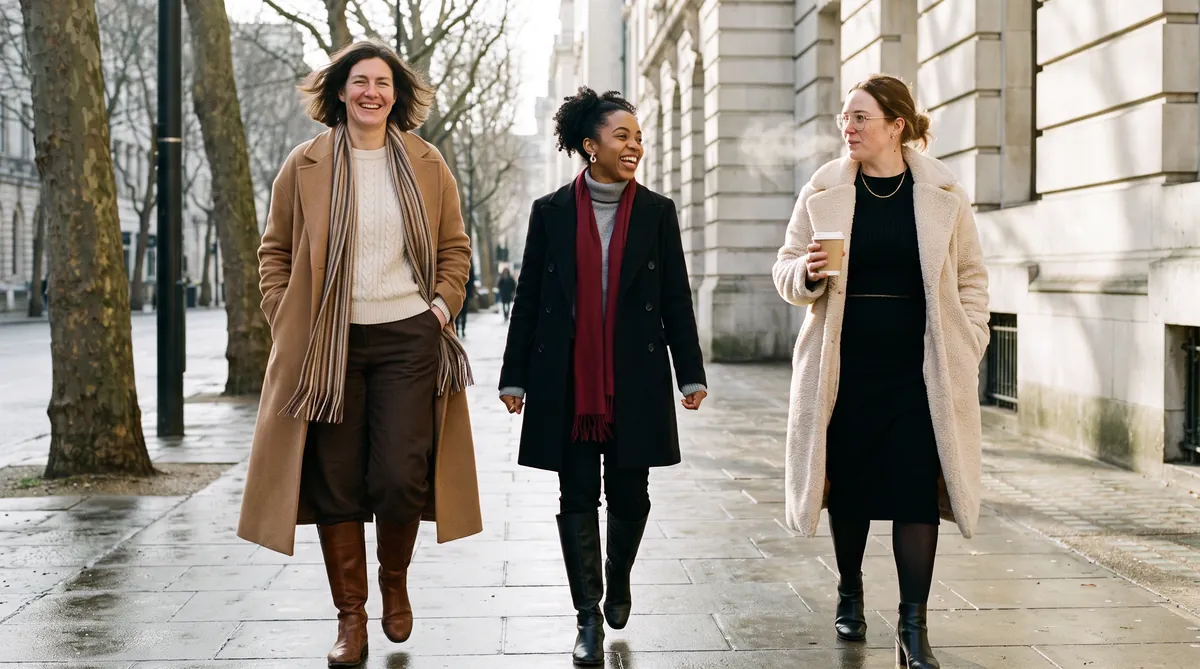
Between November and March, most of what anyone actually sees you wear is your coat. So the fastest way to dress better this winter isn't a bigger wardrobe, it's getting three things right: the coat, what sits under it, and the one piece that stops the whole look reading beige.
Below: 30 outfit formulas sorted by where you're going, plus the colour pairings, shoe swaps and layering rules that make them work when it's genuinely cold.
Coat, Core, Contrast: The Winter Formula
The three decisions that carry every cold-weather outfit.
Winter dressing collapses into three slots. Coat is the silhouette everyone sees. Core is the top and bottom underneath, and it has to work when you take the coat off indoors. Contrast is the single piece doing the visual work: a red scarf, a chocolate boot against cream trousers, a gold chain over a black roll-neck.
Most winter outfits that feel flat are missing the third slot. Everything matches, everything is neutral, and the result looks like you got dressed in the dark. One deliberate contrast fixes it faster than any new purchase.
The slot that gets skipped in the other direction is the core. If your coat only closes over a t-shirt, it's not a winter coat, it's a spring coat you're wearing in the wrong season. Buy or choose outerwear one size up from your knit, not your bare arms.
The rule: Coat, Core, Contrast. If you can't name all three in the outfit, it isn't finished.
8 Winter Work Outfits
Office-ready combinations that survive the walk in.
Work is where winter dressing gets hardest, because you need something that looks intentional under fluorescent light and doesn't leave you frozen at the bus stop. These eight are built to do both, and every one of them keeps the slim-on-one-half rule.
| # | Coat | Core | Shoes | Contrast |
|---|---|---|---|---|
| 1 | Camel long wool | Cream fine knit + chocolate wide trousers | Brown leather loafers | Tonal brown bag |
| 2 | Black tailored wool | Grey roll-neck + black straight trousers | Black knee boots | Silver hoops, red lip |
| 3 | Charcoal double-breasted | White shirt + navy tailored trousers | Navy ankle boots | Burgundy leather belt |
| 4 | Cream teddy or borg | Black fitted knit + black midi skirt | Black opaque tights, block heel | Gold chain |
| 5 | Navy wool blend | Striped cotton shirt + cream trousers | Tan loafers | Cognac tote |
| 6 | Olive utility parka | Oatmeal cable knit + dark straight jeans | Chelsea boots | Rust scarf |
| 7 | Grey checked overcoat | Black roll-neck + grey wool trousers | Black loafers | Black leather crossbody |
| 8 | Chocolate wool wrap | Butter-yellow knit + chocolate trousers | Brown knee boots | Tonal, no accessory |
Number four is the one I keep coming back to on the coldest days. Opaque tights under a midi skirt are genuinely warmer than most trousers, because the wool skirt traps air the way a trouser leg doesn't, and it reads far more considered than a jeans-and-jumper default.
Pro tip: Buy tights in 80 denier or above for winter. Anything thinner is a cold-weather illusion and ladders within a week.
If your office runs warm, swap the roll-neck for a fine merino crew and carry the extra layer rather than wearing it. For more on the underlying dress codes, our office outfit guide breaks down what smart casual actually means in practice.
Casual Winter Outfits: Six Weekend Scenarios
Real situations, not vague categories.
It's Saturday, it's four degrees, and you're doing three errands and meeting a friend for coffee. Here's how six common weekend days actually get dressed.
- Errands and a coffee: dark straight jeans, cream chunky knit tucked at the front only, white leather sneakers, long camel coat, striped scarf. The front tuck is what separates this from loungewear.
- A walk somewhere cold and muddy: fleece-lined leggings under straight jeans (yes, both), waterproof boots, quilted jacket over a hoodie, beanie. Nobody looks glamorous here and that's fine.
- Lunch with people you want to impress slightly: black wide-leg trousers, fitted grey roll-neck, brown knee boots, chocolate wool coat, gold hoops.
- A day at home that involves leaving once: grey joggers stay, but swap the sweatshirt for a proper knit and the slippers for Chelsea boots before you open the door.
- Weekend market or vintage shopping: dark jeans, an oversized shirt worn as a mid-layer over a t-shirt, puffer vest, trainers, crossbody bag. The vest is warmer than it looks and keeps your arms free.
- Driving somewhere for the day: anything except a long coat. Long coats and car seats are miserable together. Use a cropped puffer or a short quilted jacket instead.
That last one sounds small and isn't. If your commute is a car rather than a pavement, your best-looking coat may be the wrong coat five days out of seven.
The fix: Match the coat to the journey, not to the outfit. The journey wins.
Going Out in Winter Without Freezing
Five evening looks that account for the walk from the taxi.
Evening winter dressing has one specific problem: the outfit is for indoors, the weather is not. The trick is choosing pieces that hold up when the coat comes off, then treating the coat as a genuine part of the look rather than something to hide in the cloakroom.
- Black satin slip midi, fine black roll-neck worn underneath it, knee boots, long black wool coat. The roll-neck under a slip dress is the single most useful winter evening trick there is.
- Dark wide-leg trousers, a sequinned or metallic top, black blazer, heeled ankle boots, wool coat over the top.
- Velvet blazer, black straight jeans, silk cami, pointed boots. Velvet is warmer than most people expect.
- Long-sleeved knitted midi dress, tall boots, statement earrings, teddy coat. One piece, no styling decisions, works from November through February.
- Leather or faux-leather trousers, cream cashmere knit, gold jewellery, cropped puffer for the journey and a clutch for inside.
For occasion-specific rules, from work parties to New Year, our Christmas party outfit guide covers the dress codes these formulas plug into.
The Temperature Question
What actually changes as the thermometer drops.
People ask what to wear at a given temperature far more than they ask about style, and the honest answer is that the outfit barely changes. What changes is the layer count and the coat weight.
| Temperature | Coat | Layers under | Legs | Extras |
|---|---|---|---|---|
| 10°C / 50°F | Trench or light wool | One knit | Jeans or trousers | None needed |
| 5°C / 40°F | Wool overcoat | Knit + long-sleeve tee | Jeans, or skirt with 80 denier | Scarf |
| 0°C / 32°F | Insulated or heavy wool | Merino base + knit | Lined trousers or tights under trousers | Scarf, gloves, hat |
| Below −5°C / 23°F | Down parka | Merino base + fleece or wool mid | Thermal leggings under everything | All of the above, plus proper boots |
Six more outfits live inside that table, one per row and per variation, and they're all the same three slots with different weights. Our 40 degree weather guide and the winter wear guide go deeper on fabrics and heat loss if you want the technical side.
Layering rule: Thin next to skin, thick in the middle, windproof on the outside. Reversing that order is why people feel cold in three jumpers.
Three Winter Colour Palettes
Pick one per outfit and stop mixing systems.
Winter wardrobes go wrong on colour more than on shape. The fix is choosing a palette for the outfit before you choose the pieces.
All-neutral works with camel, cream, oatmeal, chocolate and grey. Vary the texture instead of the colour: a cable knit against smooth wool trousers against a leather boot. Five outfits here, and they photograph beautifully.
Dark plus one. Black or charcoal head to toe, then a single saturated piece. Red scarf, cobalt knit, forest bag, burgundy boot. This is the highest-impact and lowest-effort palette in winter, and it's the reason a plain black coat with a red scarf always looks deliberate.
Tonal. Three shades of the same family: sand, camel, chocolate. Or ice blue, mid blue, navy. Harder to build and worth it, because it reads as a decision rather than an accident.
If colour is where you get stuck, the colour analysis guide helps you work out which of the three suits you before you commit money to a coat.
What Goes Wrong
Four failures cover most disappointing winter outfits.
Bulk on bulk is the first. Oversized coat, oversized knit, wide trousers, chunky boot. Each piece is fine and together they erase you. Keep one half slim.
The second is a coat that doesn't close over your actual winter layers, which turns every cold morning into a choice between warm and dressed.
The third is footwear. A good outfit ending in a wet, salt-stained sneaker is a wasted outfit, and no amount of styling above the ankle rescues it.
The fourth is the accessory gap. In summer, the outfit is the clothes. In winter, the clothes are mostly hidden, so the scarf, bag and jewellery carry a much larger share of the look. Treat them as part of the outfit rather than as things you grab on the way out.
Bottom line: In winter the coat, the shoes and the scarf are doing 80 percent of the visual work. Spend your attention there.
Building the 30 From What You Own
Nearly every formula above uses the same core: a neutral coat, two knits, a straight trouser, a dark jean, a midi skirt or dress, one pair of boots and one pair of loafers. That's the actual list. The variation comes from the contrast slot, which costs almost nothing.
Before buying a coat this season, it's worth seeing how it sits with the knits and boots you already have. Tools like Klodsy let you try the combination on your own photo first, which is a cheaper way to find out that the cream teddy coat fights everything else you own.
Start with one formula from the work table and one from the weekend list, wear them this week, and build outward. If you want a structured version of the same idea, the capsule wardrobe planner turns these pieces into a full season's rotation, and plus size outfit ideas applies the same three-slot logic across a wider range of shapes.
Ready to see these on you rather than on a table? Try Klodsy and build your winter looks from the clothes already in your wardrobe.
Related Articles
Business Casual Outfits for Women: 12 Fall and Winter Looks
Twelve business casual outfits for women for fall and winter workdays, built from trousers, knits and boots you likely own, so you stop guessing at 7 a.m.
Black Boots Outfits: Ankle, Knee-High and Over the Knee
Black boots outfits by height: ankle, knee-high and over the knee. The hem, trouser and heel that work with each, plus the mistakes that shorten your leg.
Leather Jacket Outfits: 20 Looks Beyond the Biker Cliché
Leather jacket outfits that don't read as costume: 20 looks for dinner, errands, concerts and work, plus fit rules, colors past black and faux vs real.
Frequently Asked Questions
Everything you need to know about this topic
Build every look from three parts: a coat that fits over a sweater, a slim base underneath, and one contrast piece such as a coloured scarf or a boot in a different tone. That structure gives you dozens of outfits from around ten pieces.