
Leather Jacket Outfits: 20 Looks Beyond the Biker Cliché
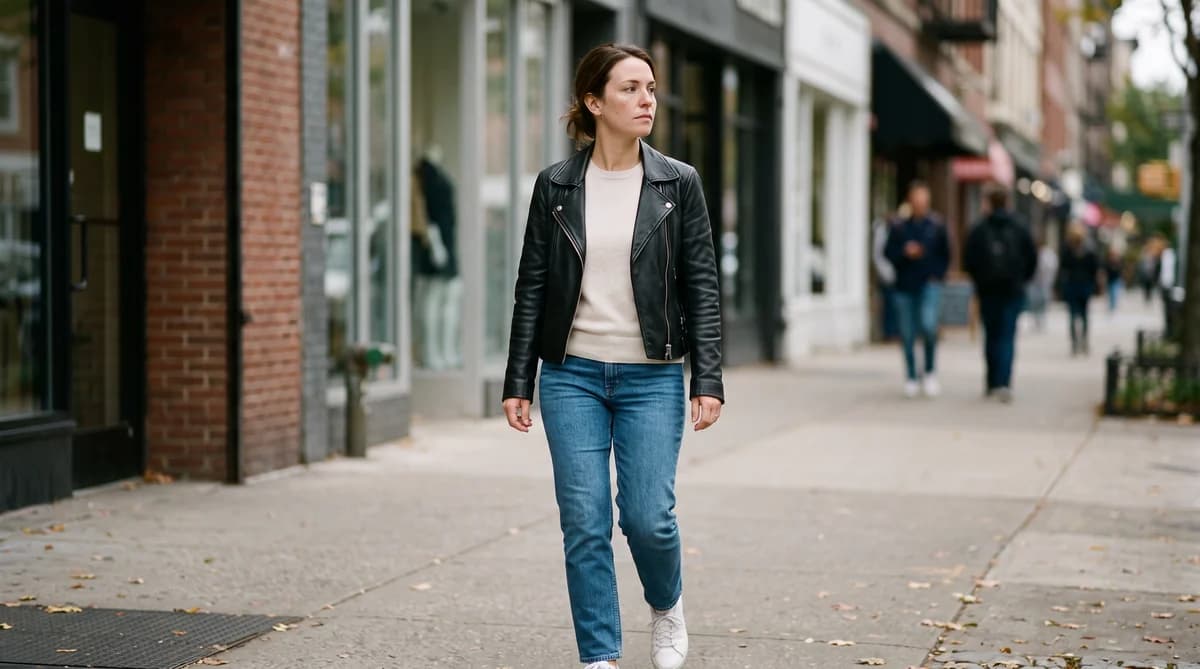
Most people who want a leather jacket never buy one, and the reason is oddly specific: they're afraid of looking like they're in costume.
Fair worry, fixable problem. The costume effect almost never comes from the jacket itself. It comes from stacking three or four tough signals in a single outfit. Below: the fit rules that decide everything, what goes underneath, twenty outfits across real settings, the colors past black, an honest read on faux, and the places a leather jacket genuinely doesn't belong.
The Costume Problem Is a Stacking Problem
One hard piece per outfit, and the jacket is already it.
Picture the version that goes wrong. Black moto jacket, black skinny jeans, black boots with buckles, dark sunglasses, a bag with studs on it. Every item is saying the same thing at the same volume, and at some point the outfit stops reading as clothes and starts reading as a character.
Now change two things. Same jacket, mid-blue straight jeans, a cream sweater, brown loafers. Nothing about the jacket moved, but it now reads as a person who owns a leather jacket rather than a person dressed as one.
That's the entire framework, and it's three words: Shoulders, Softness, Restraint. Shoulders means the fit is right, and nothing else matters if it isn't. Softness means at least one genuinely soft thing in the outfit, a knit, cotton, silk, anything that gives. Restraint means the jacket is the only hard element in the frame.
All-black is still available to you. It just has to be built on differences in texture rather than color, which is a separate skill and one our black outfit ideas guide works through properly.
The rule: if the boots have hardware and the jacket has hardware, one of them is wrong.
Fit: The Two Things a Tailor Can and Can't Fix
Leather has no drape, so it hides nothing.
The shoulder seam should sit at the outer edge of your shoulder bone and lie flat against it. Not down on the upper arm, not short of the joint. Wool can fudge this, leather can't, and a seam that droops past the shoulder produces the borrowed-jacket look that reads as costume before anyone registers the color. It's also the alteration nobody can do cheaply, since moving a shoulder means taking the jacket apart and rebuilding it.
Sleeve length is the opposite case. Sleeves should stop at the wrist bone or just above, and a leather specialist can shorten them. The catch is the cuff zipper most moto jackets have, because shortening the sleeve means relocating that zipper, and the bill runs higher than the same job on a wool coat. Ask about it before you buy, not after.
Side seams can be taken in by someone who actually works in leather, with one permanent caveat: every needle hole stays. Unpick a seam in wool and the fabric closes up. Unpick a seam in leather and you've left a dotted line. That's the argument for buying slightly snug, since leather stretches with wear and never shrinks back.
A leather jacket bought a size up on purpose, to leave room for layering, rarely gets worn. The shoulders sit an inch too wide and everything underneath looks like it belongs to someone taller.
One test people skip: zip it up and cross your arms in front of you. If you can't, the back panel is too narrow, and no alteration adds material that isn't there.
Fit rule: buy for the shoulder and the back. Everything else is negotiable, expensive, or both.
What Goes Underneath
The layer that decides whether the jacket reads hard or easy.
Thin and soft is the answer almost every time. Leather sleeves have a fixed circumference, so a chunky cable knit either won't go in or will bunch at the armhole and drag the shoulder seam out of position. Fine merino, a cotton tee, a ribbed turtleneck, a silk camisole: all of them sit flat and leave the jacket's line intact. This is the Softness half of Shoulders, Softness, Restraint, and it's the cheapest of the three to get right.
Color underneath does more than people expect. Cream, camel, butter yellow and pale grey pull a black jacket toward daytime. Black, charcoal and deep red push it toward evening. This is the fastest dial you have, faster than changing shoes, and it costs nothing.
Length matters too. If the jacket is cropped and the top underneath hangs long, you get a two-tier hem that reads as an accident. Tuck the top, or match the two lengths roughly.
10 Leather Jacket Outfits, by Where You're Going
Copy these directly. Every one keeps the jacket as the only hard piece.
| # | Occasion | Jacket | Underneath | Bottom | Shoes |
|---|---|---|---|---|---|
| 1 | Weekend errands | Black moto | Grey crewneck sweatshirt | Mid-blue straight jeans | White leather sneakers |
| 2 | Dinner out | Black moto | Ivory silk camisole | Black wide-leg trousers | Pointed flats |
| 3 | Concert | Black moto | Soft washed band tee | Dark straight jeans | Black ankle boots |
| 4 | Office-casual Friday | Chocolate bomber | Cream fine-gauge knit | Camel wide-leg trousers | Brown loafers |
| 5 | Cold school run | Black moto | Cream turtleneck | Dark straight jeans | Chelsea boots |
| 6 | Drinks after work | Black moto | White poplin shirt, untucked | Black straight trousers | Black loafers |
| 7 | Saturday market | Cognac racer | Olive cotton tee | Cream wide-leg jeans | Tan suede sneakers |
| 8 | Travel day | Chocolate bomber | Grey ribbed long-sleeve | Black straight trousers | White sneakers |
| 9 | Autumn walk | Black moto | Rust fine knit | Dark straight jeans | Brown boots |
| 10 | Late dinner, dressed up | Black moto | Black fine knit | Emerald satin midi skirt | Black heeled boots |
Number ten is the one worth stealing. Satin against leather is the sharpest contrast on this list, and it does more for an evening outfit than any amount of jewelry.
Four of those rows run on straight jeans, which isn't laziness. Straight and slightly relaxed denim balances a cropped jacket better than skinny does, and the reasoning sits in our guide to what to wear with jeans. For row three, what to wear to a concert covers venue, weather and the standing-for-four-hours problem.
Beyond Black: Brown, Cognac, Cream, Oxblood
Black is the loudest color a leather jacket comes in, not the safest.
Black carries the whole moto association by itself. Brown carries almost none of it, which is why a brown leather jacket is the easier first purchase for anyone whose actual fear is the costume thing. Four that work:
- Chocolate brown bomber, cream cable knit, dark indigo straight jeans, brown suede boots. The warmest, least aggressive leather outfit there is.
- Cognac racer, white tee, olive chinos, white sneakers. Reads like a spring jacket rather than a moto piece.
- Bone or cream moto, grey marl sweatshirt, mid-blue jeans, cream sneakers. The cream version dresses down further than black ever will.
- Oxblood moto, black turtleneck, black straight trousers, black loafers. One color break in an otherwise dark outfit, and it carries the whole thing.
Whether brown or black sits better against the clothes you already own is genuinely hard to judge under store lighting. Tools like Klodsy let you put both on your own photo, with your own sweaters, before you commit to one.
Color rule: buy the color that matches the clothes you own most of, not the color leather jackets are supposed to be.
Leather Jacket With a Dress
Three scenarios, three different dresses, one jacket.
- It's a Thursday and dinner is at eight. Black slip dress, black moto over it, heeled ankle boots, nothing else. The jacket supplies the structure a slip dress has none of, which is why this pairing has outlived every trend it's been attached to. More of this thinking in date night outfit ideas.
- It's mid-September, sixty-five degrees, and you're not ready to give up summer dresses. Floral midi, brown bomber, white sneakers, bare legs. Brown keeps it soft where black would make the dress look interrupted.
- It's November and you want a dress anyway. Ribbed knit midi dress, opaque tights, cropped black moto, tall boots. Cropped is load-bearing here, because a long jacket over a long dress leaves no visible shape anywhere. Footwear is half of this outfit, and black boots outfits sorts through the options.
Fall Layering, by Temperature
Where the jacket earns its place in the rotation.
| Outside | Under the jacket | The outfit |
|---|---|---|
| Around 65F | Nothing extra | Black moto, white tee, straight jeans, white sneakers |
| Around 50F | One knit layer | Chocolate bomber, camel fine knit, corduroy trousers, brown boots |
| Around 40F | Knit, and the jacket goes under a coat | Wool turtleneck, black moto, oversized grey wool coat, dark jeans, boots |
The third row is the move almost nobody tries. A leather jacket worn as a mid-layer under a big wool coat is warmer than either piece alone, and it stops the jacket from vanishing for four months of the year. The rest of the seasonal math lives in our fall outfit ideas guide.
Bottom line: a leather jacket is a windbreaker, not a coat. Below roughly 45F it needs help.
Real or Faux, Honestly
Four questions people actually ask, answered without the marketing.
"Can people tell?" At conversational distance, usually not, if the faux is decent. Cheap faux gives itself away in three places: the collar fold, the cut edges of the seams, and how sharply it creases at the elbow. Heavier polyurethane with a matte finish holds up fine.
"Does real leather last longer?" Generally yes, and the failure modes differ. Real leather softens, darkens at the wear points and molds to your shoulders. Faux doesn't improve with age, and the surface layer can crack or peel where it flexes most, at the elbows and inside the cuffs. That said, a badly made real jacket with thin split leather and glued seams will lose to a good faux.
"Is real warmer?" No. Both block wind, neither insulates, and the lining is what actually keeps you warm. A quilted lining in faux beats an unlined lambskin in February.
"What should I check in the store?" Pick it up. Real lamb feels supple and warms to your hand, and heavier cowhide from a maker like Schott has an obvious weight to it. Then look at the lining, work the zipper twice, and check the shoulder. AllSaints built its reputation on the softer washed-lamb version of this jacket, and Madewell sells both real and vegan cuts in the mid range, so the choice isn't only a price question.
Where a Leather Jacket Doesn't Work
Three settings where it's the wrong answer, no matter how good the jacket is.
| Setting | Why it fails | Wear instead |
|---|---|---|
| Interviews, business formal | It's outerwear with an attitude and it carries no formality signal | A wool blazer or a plain overcoat |
| Funerals, somber occasions | Shine and hardware pull attention in a room where you don't want any | A matte dark coat, nothing reflective |
| Anything above about 75F | No breathability, so you'll carry it in your arms all afternoon | Denim jacket or a light overshirt |
The interview case is worth spelling out, since it's the one people push against. A leather jacket over a good shirt still reads as a jacket you happened to arrive in, not part of the outfit. If the setting calls for structure, our blazer outfits guide covers the piece that actually does that job.
What Goes Wrong
Five failures, roughly in order of how much damage they do.
Shoulders too wide. Everything else on this list is recoverable and this one isn't, which is why it goes first.
Sleeves bunched at the wrist. Leather doesn't fall the way wool does, so extra length concertinas into rings above your hand and ages the whole jacket.
Leather trousers with a leather jacket. Two hard pieces, no contrast, and the outfit reads as a single costume rather than two garments. Same problem with leather skirt plus leather jacket unless the textures are genuinely different.
Zipping it over a thick sweater. The jacket strains, the shoulder line breaks, and you end up looking wider through the chest than you are.
Only wearing it out at night. A jacket that appears exclusively after dark stays exotic, and exotic is one step from costume. Wear it to the grocery store on a Tuesday and the association dissolves within a month.
Getting It Into Rotation
The last step is wearing it on a completely ordinary day.
The jacket that ends up worn is almost never the most impressive one in the store. It's the one whose shoulders fit and whose color agrees with the sweaters already in your closet, which is why Shoulders, Softness, Restraint is a buying checklist as much as a styling one.
Start with the plainest outfit on the list. Grey sweatshirt, straight jeans, white sneakers, jacket on top. Wear that version four or five times until it stops feeling like a decision, then work up to the satin skirt and the slip dress.
Try Klodsy and see how a leather jacket sits with the clothes you already own before you spend anything.
Related Articles
Should I Wear a Jacket Today? Temperature Chart + 5 Checks
Should you wear a jacket today? Use the temperature chart, then check wind, rain, sun and activity to choose the right jacket, from 70°F down to freezing.
Grunge Outfits: 12 Ideas From 90s Flannel to Soft Grunge
Grunge outfits with photos: 12 looks from 90s flannel and slip dresses to soft grunge for fall, three for men, and what keeps grunge from looking messy.
Business Casual Outfits for Women: 12 Fall and Winter Looks
Twelve business casual outfits for women for fall and winter workdays, built from trousers, knits and boots you likely own, so you stop guessing at 7 a.m.
Frequently Asked Questions
Everything you need to know about this topic
Let the jacket be the only tough thing in the outfit. The costume effect comes from stacking signals: black moto jacket plus black skinny jeans plus hardware boots plus dark sunglasses. Swap two of those for something soft or mid-toned and the same jacket reads as normal clothes.