
Fall Outfit Ideas 2026: What to Wear This Autumn
Fall Isn't One Season, It's Three
September, October, and November barely share a wardrobe.
The mistake most fall outfit lists make is treating autumn as one temperature. It isn't. Early fall is summer wearing different colors, mid fall is the actual layering season, and late fall is winter with better light. An outfit that works in the first week of September looks absurd in the second week of November, and the reverse is worse.
So this guide is built the way the season actually behaves, as a slide from warm to cold. The thread that runs through all three phases: Layer, Texture, Tone. Layers manage the temperature swings, texture makes simple outfits look considered, and warm tones do the seasonal signaling that no single garment can. That formula holds from the first cool evening to the last week before winter coats take over.
| Phase | Rough temps | What changes |
|---|---|---|
| Early fall (Sept) | Warm days, cool evenings | Colors and shoes shift, fabrics stay light |
| Mid fall (Oct) | Genuinely crisp | Real layering begins, boots take over |
| Late fall (Nov) | Cold mornings, short days | Coats, knits doubled, scarves working |
Early Fall: Summer Clothes, Autumn Signals
Dress for the thermometer, style for the calendar.
September's problem is that it feels like summer at 2pm and like October at 8pm. The answer isn't warmer clothes, it's autumn signals on summer-weight outfits. Keep the light trousers or the midi skirt, then change what surrounds them: closed loafers or clean leather sneakers instead of sandals, a long-sleeve tee pushed up at the sleeves instead of a tank, rust or olive instead of white and sky blue.
A light overshirt is the hero piece of this phase. Worn open over a tee it's a jacket, buttoned it's a shirt, tied at the waist or thrown over a shoulder it's an accessory, and it fits in a tote bag when the afternoon turns warm. Chambray, cotton twill, or a light flannel all work; the point is having somewhere to go when the temperature drops after sunset.
Summer dresses stay in play too. Warm-toned midis just need the sandals swapped for boots or loafers and a knit within reach. It's the cheapest wardrobe extension of the year: nothing new bought, three more months of wear.
The rule: in September, change your colors and your shoes before you change your fabrics.
Mid Fall: The Actual Layering Season
October is what the whole season is advertised as.
Crisp mornings, cool afternoons, cold evenings. This is the stretch where layering stops being optional styling and starts being how you get through the day comfortably, and the thin-to-thick rule keeps it from turning bulky. A fitted base layer, a structured mid layer, one voluminous piece on top, never two thick layers stacked.
In practice, the combinations that carry October look like this:
| Base | Mid | Top layer | Feet |
|---|---|---|---|
| Fitted tee | Flannel or fine crewneck | Trench or barn jacket | Ankle boots |
| Thin turtleneck | Open cardigan | Leather or suede jacket | Loafers with socks |
| Shirt, collar out | Sweater over it | Wool overshirt | Clean sneakers |
| Slip dress or midi | Fine knit over the dress | Trench | Knee or ankle boots |
Texture earns its keep here. A plain sweater over plain trousers reads flat; the same outfit with corduroy, suede, ribbed knit, or brushed flannel somewhere in it reads deliberate. This is also where the classic autumn palette, rust, chocolate, olive, camel, cream, burgundy, does more work than any trend piece. Warm tones plus visible texture is the entire recipe for looking like you tried.
Denim deserves its own line: straight or wide-leg jeans anchor half the season's outfits, and denim-on-denim, a jacket over a different wash of jeans, has settled back into normal rotation. Keep the two washes clearly different and it works without effort.
Pro tip: when an outfit feels boring, change a texture before you add a piece. Swapping smooth cotton for ribbed knit does more than a third layer ever will.
Late Fall: Cold-Weather Outfits With Autumn Colors
November is winter dressing in a warmer palette.
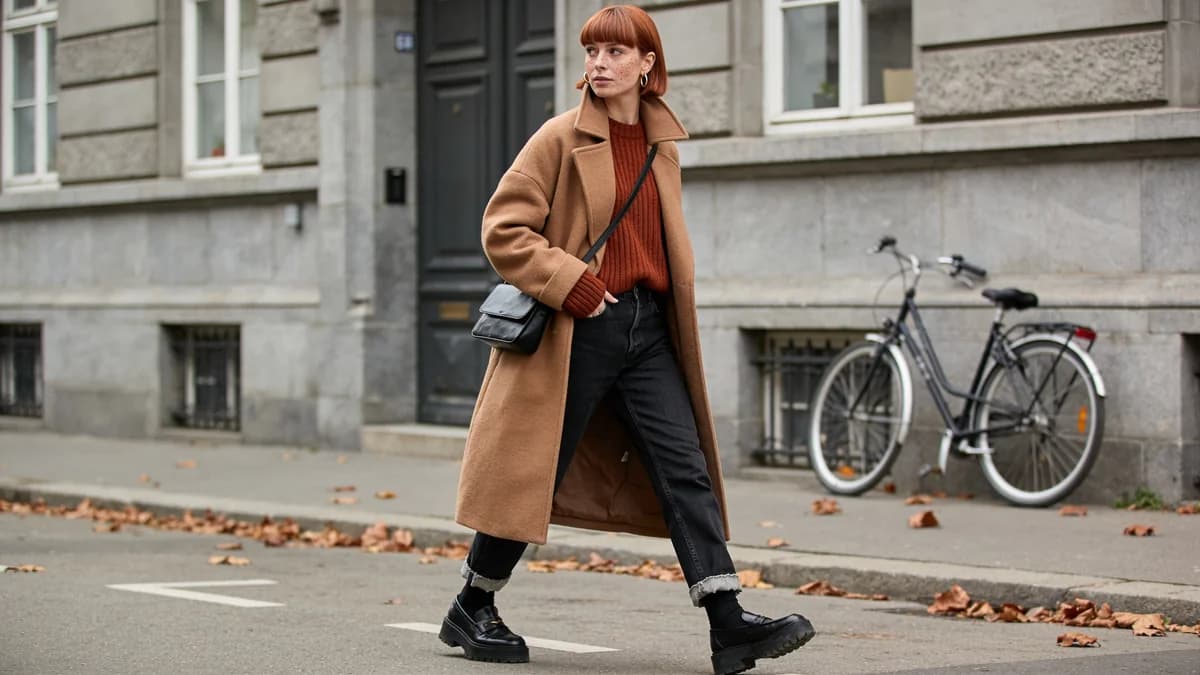
By November the layering game simplifies: a real coat over a warm outfit, and the interest moves to what shows around the coat. The scarf, the knit collar at the neckline, the boots, the trouser hem. A camel or gray wool coat over rust and cream reads unmistakably autumn even in near-winter temperatures, which is exactly the trick this phase requires.
Knits double up now, a fine turtleneck under a heavier crew or cardigan, and tights turn the remaining dresses and skirts into cold-weather outfits. Boots go from stylistic choice to daily equipment, which is why a pair you can genuinely walk in beats a pair that photographs slightly better.
The mornings in this phase overlap with what we cover in the 50-degree weather guide, and once daytime highs stop reaching that range, you're in winter wardrobe territory and the fall rotation has done its job. If Thanksgiving hosting or travel lands at the end of this stretch, the Thanksgiving outfit guide handles that specific day's comfort math.
A Small Fall Capsule That Covers All Three Phases
About a dozen pieces, most of them probably already yours.
Because the season slides rather than jumps, a small set of compatible pieces covers it better than a big wardrobe of single-outfit items. A workable fall capsule looks like this: two or three knits in warm tones, one flannel or overshirt, a trench or barn jacket, one heavier coat, straight or wide-leg jeans plus one non-denim trouser, a midi dress or skirt that takes tights, ankle boots, one flat alternative, and a scarf.
That's roughly twelve pieces, and the arithmetic works because everything shares the same palette. Rust knit with camel coat, olive overshirt with cream tee, burgundy scarf over any of it. When each piece pairs with most of the others, a dozen items produce weeks of distinct outfits, the same math from our capsule wardrobe guide applied to one season.
The honest test for adding anything new this fall: does it work in at least two of the three phases? A blazer that layers over a tee in September and under a coat in November earns its place. A statement piece that only functions in one two-week window probably doesn't.
Bottom line: buy for the season's arc, not for one perfect October photo.
Getting Dressed Faster While It All Changes
The awkward part of fall is that no formula survives the whole season, what worked last week runs hot or cold this week. The fix is less about owning more and more about seeing the combinations you already have. Layer, Texture, Tone narrows the choices; a quick look at tomorrow's forecast picks the phase.
If you'd rather test the combinations on yourself than on the bed, try Klodsy and build the week's fall outfits from your own closet in minutes.
Related Articles
Black Jeans Outfit Ideas: 12 Looks You Can Copy Tonight
12 black jeans outfit ideas with photos for women and men, office to night out, plus the fade rule nobody tells you: jet black dresses up, faded dresses down.
What to Wear to a Fall Wedding: Every Dress Code, Solved
What to wear to a fall wedding as a guest, by dress code: colors that photograph well in October, layers so you won't freeze at the ceremony, men's looks.
Black Boots Outfits: Ankle, Knee-High and Over the Knee
Black boots outfits by height: ankle, knee-high and over the knee. The hem, trouser and heel that work with each, plus the mistakes that shorten your leg.
Frequently Asked Questions
Everything you need to know about this topic
Keep summer bottoms and switch the signals: closed shoes instead of sandals, a long-sleeve tee or light shirt instead of a tank, one autumn color like rust or olive. September is about looking like fall while dressing for late-summer temperatures, and a light layer you can carry covers the cooler evenings.