
What to Wear in London: Style Guide for Visitors 2026
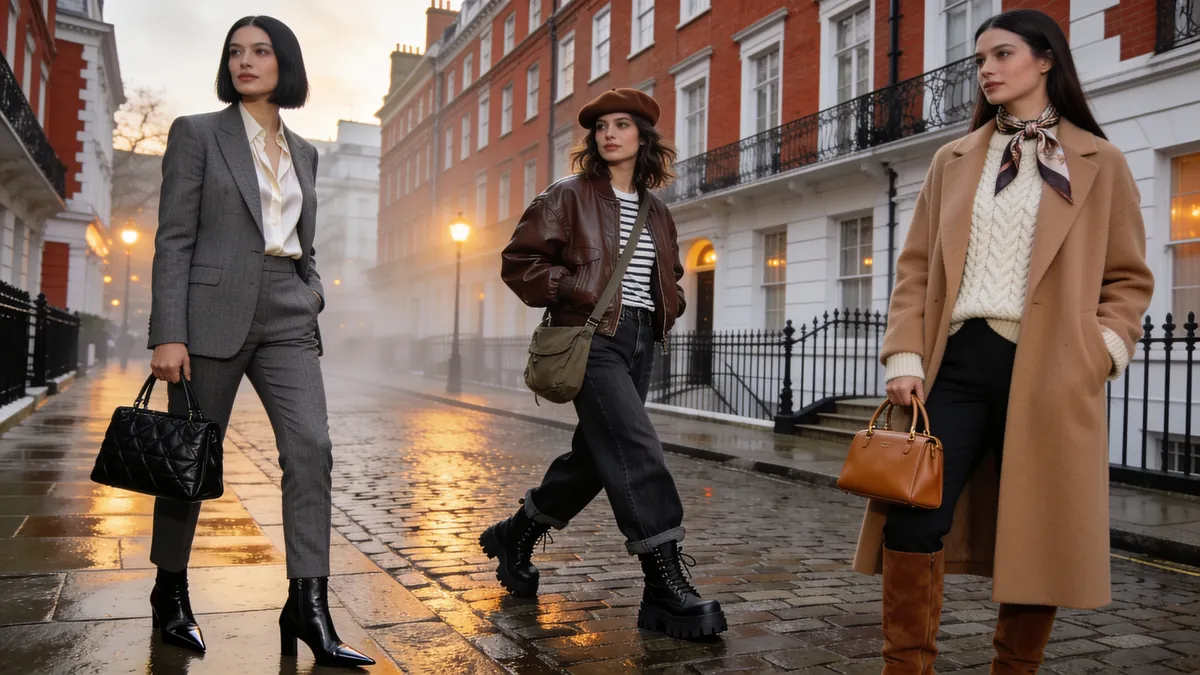
London's weather has an agenda of its own, and the city's dress code is more specific than most visitors expect.
Pack a trench coat. Bring layers. Ignore anyone who tells you London is just like any other European city to dress for, because the Tube alone changes everything.
The London Wardrobe Formula: Layer, Waterproof, Repeat
London's packing problem has three variables working against you simultaneously: rain that arrives without warning, temperatures that shift by 10 degrees between morning and afternoon, and the underground heat of the Tube turning whatever you wore outside into a mistake within three stops.
The formula that handles all three: base layer + mid layer + waterproof outer + shoes that handle cobblestones. Every outfit you build for London should answer these four questions before you leave the flat.
That's the framework. Below: the weather reality, the London uniform, seasonal breakdowns, a neighborhood guide, tourist mistakes, a packing list, and practical transport tips.
London's Weather Reality: What You're Actually Dealing With
More nuanced than just "bring an umbrella", though you should absolutely bring an umbrella.
London gets around 1,500mm of annual rainfall, but the nature of that rain is what surprises visitors. It rarely pours for hours. It drizzles persistently, clears up, then drizzles again. You can leave the hotel in sunshine and return damp without ever experiencing what you'd call a proper downpour. This is why a compact folding umbrella earns its suitcase space year-round, not just in winter.
Temperature ranges are genuinely mild by global standards: winter sits around 3 to 8°C (37 to 46°F), spring and autumn around 10 to 18°C (50 to 65°F), and summer averages 15 to 22°C (59 to 72°F) with occasional heatwaves pushing toward 30°C or beyond. The catch is the internal range within a single day. A London June morning at 13°C can become a sticky 23°C afternoon, which makes any single-layer approach feel wrong by noon.
Then there's the Tube. The Central, Northern, and Victoria lines run deep underground with minimal modern cooling infrastructure, and summer temperatures on platforms and carriages routinely exceed 30°C. If you board in a coat that's already doing its job outdoors, you'll be uncomfortable within minutes. Layers you can strip and stow are not optional in summer.
Cobblestones deserve a separate mention. Parts of Covent Garden, much of the City of London, and stretches of South Bank and Southwark have uneven stone surfaces that punish thin heels and worn soles. You can walk beautifully through London in block-heeled boots, leather trainers with good grip, or cushioned loafers. Stilettos and flimsy sandals are a different story.
The rule: One compact umbrella, one waterproof outer layer, and shoes with a real sole. Everything else is seasonal adjustment.
The London Uniform: How Locals Actually Dress
Not as fashion-forward as you might expect, not as casual as tourists assume.
London has a population of over 9 million and a fashion culture that's genuinely hard to pin down because the city is so internally varied. But there is a default mode that emerges across ages and neighborhoods: smart casual, leaning dark.
Dark straight-leg or slim jeans form the base of countless London outfits. Paired with a nice top, a clean shirt, or a fitted knit, they work for most of the city's day and evening settings. A blazer or trench coat over that combination upgrades it for dinner, theatre, or a more formal setting. Trainers (what the British call sneakers) are everywhere, but they're typically clean and relatively minimal rather than chunky or statement-making.
Color-wise, London runs darker than southern European cities. Navy, black, charcoal, burgundy, and camel dominate in autumn and winter. Summer loosens things up with lighter tones but rarely reaches the white-linen-in-Positano register. Even in warm weather, Londoners tend toward muted palettes: dusty blue, sage, pale grey, soft white.
Marks & Spencer remains genuinely popular for everyday knitwear and basics, which says something about how most Londoners dress. Reiss is the smart-casual default for occasions that need an upgrade without formal wear. COS fills the minimalist, architectural-cut corner of many London wardrobes. Women looking for a polished everyday coat or dress often reach for Whistles or ME+EM. And Burberry, despite being a luxury brand, came from London and the trench coat it made iconic still appears constantly on London streets in exactly the way it was designed to be worn: practical outerwear that also looks sharp.
Bottom line: The London uniform is not flash. It's smart, dark, and weather-ready. Fit matters more than brand, and a clean coat over jeans takes you almost anywhere.
What to Wear in London by Season
Spring (March through May)
Spring in London is the season of false starts. A sunny 16°C Tuesday in April gets followed by a wet 9°C Thursday. Daffodils bloom in Hyde Park while commuters still commute in scarves. You want clothing that can do both.
Layering is the whole strategy here. A long-sleeve cotton top or light knit as a base, a cardigan or fitted jumper in the middle, and a trench coat or waterproof light jacket on top handles the full range of a spring day. Mid-weight ankle boots with a low block heel are the ideal footwear: weather-appropriate, comfortable over distance, and sharp enough for anywhere you'd want to go.
Spring outfit formula:
Long-sleeve top or light knit + cardigan or mid-layer + trench coat (classic tan Burberry-style works perfectly here) + dark straight-leg jeans or tailored trousers + ankle boots + compact umbrella
Spring color palette: dusty rose, sage green, cream, soft navy. The light in London in April is genuinely beautiful, and lighter tones photograph well against the city's Georgian architecture.
Summer (June through August)
London summers are the city's most unpredictable weather window. You might get a week of 28°C sunshine, then four days of grey 17°C drizzle, then another heatwave. The preparation strategy is having one hot-day outfit and one cool-overcast outfit ready for each day's actual conditions.
The Tube heat concern intensifies in July and August. On the Central line during rush hour, platform temperatures have been recorded above 35°C. This makes anything synthetic uncomfortable and anything non-breathable genuinely miserable. Natural fibers, loose silhouettes, and layers you can carry in a bag are the practical reality.
Linen trousers, cotton dresses, and breathable shirts in lighter tones are the right call for warm days. Keep a light jacket or cardigan in your bag for the museums, restaurants, and older buildings that can be surprisingly cool even in August. And a compact umbrella remains relevant even in the height of summer.
Summer outfit formula:
Cotton or linen top + breathable trousers or a midi dress + light jacket or cardigan (stored in your bag) + leather trainers or cushioned loafers + compact umbrella
On a genuine heatwave day, a breezy cotton dress or lightweight linen shirt with wide-leg trousers handles outdoor heat and layers off quickly underground.
Autumn (September through November)
This is, in the view of many long-term residents, London's best dressing season. September and October bring the kind of 14 to 18°C weather that makes layered knitwear and quality outerwear feel exactly right. The city's parks turn golden. The light gets lower and warmer.
A good coat becomes your most important piece from mid-October onward. Wool or a wool-blend in navy, charcoal, or camel does the heavy lifting across the full autumn range. Underneath, quality knitwear (a chunky ribbed jumper, a fine merino crewneck), dark trousers or jeans, and ankle boots or Derby shoes complete a London autumn outfit that works from morning commute to evening dinner.
Autumn outfit formula:
Merino crewneck or chunky knit + tailored trousers or dark jeans + wool or wool-blend coat + ankle boots or leather Derby shoes + scarf + compact umbrella
Barbour waxed jackets appear on London streets in autumn, particularly in residential areas like Islington, Hampstead, and Chelsea. They're not just countryside gear. A Barbour Beaufort or Bedale in autumn-weight olive or navy is a legitimate London coat, and it's waterproof in a way a standard wool coat isn't.
Winter (December through February)
London winter is cold and grey but rarely brutal. The temperature stays mostly above freezing, typically between 3 and 8°C, though damp wind makes it feel colder than the numbers suggest. The bigger challenge is waterproofing: winter rain in London is persistent, and a beautiful wool coat that soaks through isn't serving you.
Your core pieces: a substantial outer coat with weather resistance, thermal or merino base layers under everything, a quality knit in the middle, and waterproof or water-resistant footwear with good grip on wet pavements. Accessories earn their keep in winter. A cashmere or wool scarf, warm gloves, and a hat for the coldest days are basics rather than extras.
Winter outfit formula:
Thermal base layer + warm knit sweater + tailored trousers or heavy jeans + substantial coat (wool-blend or waxed) + waterproof ankle boots or Chelsea boots + scarf, gloves, hat
The John Lewis menswear and womenswear floors are a practical stop for winter basics if you've underestimated London's cold. The difference between a good merino base layer and a cotton one is significant when you're walking from Tate Modern to Borough Market in February drizzle.
Neighborhood Outfit Guide
Where you're going changes what to wear as much as the weather does. London's neighborhoods have genuinely distinct dress cultures.
| Neighborhood | Vibe | Outfit to Match |
|---|---|---|
| West End (Covent Garden, Soho, theatreland) | Smart casual to smart evening | Dark jeans + neat top + blazer or trench; heels if the cobblestones permit |
| Shoreditch / Hackney | Creative, casual, fashion-conscious | Relaxed tailoring, interesting trainers, vintage pieces, graphic tees done well |
| Notting Hill / Holland Park | Polished casual, weekend affluence | Quality basics, clean trench, leather tote, understated accessories |
| The City | Corporate, formal during the week | For visitors: smart casual or business casual; for meetings: sharp tailoring expected |
| South Bank / Borough Market | Active day-walking, casual dining | Comfortable walking shoes non-negotiable, layers, jeans and a decent jacket |
| Mayfair / Knightsbridge | Upscale shopping, hotel dining | Step up the coat and bag; Selfridges, Liberty, and Harrods draw a dressed-up crowd |
The City is worth flagging separately for business visitors: London's Square Mile runs formal to smart-formal depending on the sector. Finance leans sharper than tech. A blazer and tailored trousers is the minimum; a suit is never wrong. For West End theatre, no formal dress code is enforced at most venues, but the Royal Opera House crowd does dress up properly.
Tourist Mistakes to Avoid
The things that will make a Londoner clock you as a first-timer within about four seconds.
Mistake 1: Wearing the wrong shoes for cobblestones and distance
London is a walking city, and parts of it were paved centuries ago. Thin heels on the uneven stone around Covent Garden or the Strand will leave you in real discomfort within an hour. Beyond the comfort issue, London walking distances are substantial. Borough Market to Tower Bridge is a pleasant 15-minute walk. Southbank to Tate Modern is another stretch. Budget your footwear for 15,000 to 20,000 steps on a normal sightseeing day.
Pro tip: Leather trainers with cushioning (think minimalist low-profile styles, not chunky athletic shoes) are the most versatile London footwear. They handle walking distance, look appropriate in restaurants, and work with both jeans and smarter trousers.
Mistake 2: Dressing in one layer for a whole day
Whatever the morning weather says, it's likely to change. London's forecasting is notoriously difficult because the city can get multiple micro-climates in one afternoon. A jacket stuffed in your bag costs nothing in effort and saves you from the specific misery of being cold and wet with nowhere warm to go.
Pro tip: A packable gilet or lightweight down layer adds warmth without bulk, especially useful for Tube-to-outdoors temperature shifts.
Mistake 3: Buying Hunter wellies for a city trip
Hunter rain boots have a strong country and festival association in Britain. Actual Londoners wear waterproof ankle boots, Chelsea boots with rubber soles, or regular leather shoes treated with water-resistant spray. Tall wellies look out of place on the Tube and in restaurants, and they offer no real advantage over a good ankle boot for city rain.
Pro tip: If you need rain footwear, a pair of Chelsea boots with a synthetic rubber sole handles London's drizzle better than anything else in the category.
Mistake 4: Overdressing for a London pub
The British pub has its own dress code and it's essentially the opposite of formal. The neighbourhood pub culture embraces exactly the comfortable jeans-and-jumper combination that doesn't need upgrading. Showing up to a Hackney or Bermondsey pub in your theatre outfit looks odd in both directions. Read the pub, not the country.
Pro tip: The smarter gastropubs around Chelsea and South Kensington do attract a slightly more polished crowd at dinner. But even there, jeans are fine. Athleisure is not.
Mistake 5: Forgetting that summer evenings are cool
The warmest London days can drop to 14 or 15°C after 8pm. Al fresco dining in July still often requires a layer over the evening outfit. An outdoor terrace with a heat lamp is not the same as a hot evening. Pack something that works as a smart outer layer in summer specifically for evenings: a fitted cotton blazer, a structured cardigan, or a light trench does the job.
London Packing List
A visitor's checklist for a week in London, calibrated for the city's specific demands:
- Trench coat or waterproof jacket. The single most important London garment, year-round.
- Quality ankle boots. Block heel or flat, weatherproof, with real sole traction.
- Leather trainers. Your walking-day footwear and smart-casual alternative.
- Dark straight-leg jeans. Two pairs if the trip is longer than five days.
- Tailored trousers. For dinners, theatre, or anything that needs a step up.
- Layering knits. One or two in neutral tones, weight appropriate to the season.
- Compact folding umbrella. Not optional, regardless of month.
- Cotton or linen tops. Breathable base layers that work across temperature ranges.
- One elevated top or blazer. For evenings, theatre, or restaurant dinners.
- Crossbody or structured bag. Practical for Tube travel and walking distances.
- Scarf. Doubles as warmth and weather cover for spring, autumn, and winter.
- Light cardigan or packable layer. Essential for summer Tube heat and air-conditioned buildings.
- Presentable socks. London's ankle-boots culture means sock visibility is real.
- One pair of smart casual shoes. A loafer or Derby for when trainers feel too casual.
The rule: Build your London packing list around the coat and the shoes. Every other decision follows from those two anchors.
Getting Around: Tube, Buses, and Walking
Three practical realities that should shape every outfit decision you make.
The deep-level Tube lines (Central, Northern, Victoria) run without adequate cooling on much of their network. Summer platform temperatures during peak hours regularly exceed 30°C. The fix is simple: pack layers in your bag rather than wearing them. A breathable cotton top that's comfortable underground, with a jacket you can pull out when you resurface, solves the problem cleanly.
London walking distances add up fast. The South Bank walk from Westminster Bridge to Tower Bridge covers about 3.5 kilometers alone. Factor in Borough Market, the Tate Modern, and a detour through Southwark Cathedral, and you've covered a real day's mileage before you've crossed back north. Footwear that performs over distance isn't optional.
On hot days, London's double-decker buses are genuinely the better choice over the Tube if time allows. Surface level means no platform heat, and the upper front seats offer some of the best city views available from any form of transport. Budget an extra 15 to 20 minutes and take the bus.
Pro tip: A compact folding umbrella is sold at every corner shop and newsagent in London. That tells you everything you need to know about whether to pack one.
Related Reading
- What to Wear in Paris: Style Guide for Every Season -- How London's neighbour approaches dressing, with key differences worth knowing before a European trip
- What to Wear in Italy: City-by-City Outfit Guide -- For trips that extend south into warmer, more formal territory
- What to Wear in Spain: Complete Travel Style Guide 2026 -- Mediterranean contrast to London's grey-sky aesthetic
- Smart Casual Outfit Ideas for Any Occasion -- The dress code that covers most of London's settings
- Smart Casual vs Business Casual -- Useful if you're mixing tourism with London business meetings
- How to Plan Vacation Outfits Using an AI Outfit Planner -- For packing light without leaving gaps
Planning a London wardrobe means balancing weather unpredictability, neighborhood variation, and the physical demands of Tube travel and serious walking. If you want to test outfit combinations from your existing wardrobe before you pack, Klodsy can help you see what works together and spot any gaps worth filling before you leave.
Related Articles
Airport Outfit Ideas: What to Wear for Comfort and Style
Discover the best airport outfit ideas for every season. TSA-friendly tips, layering tricks, and outfit formulas for comfortable, stylish travel.
What to Wear in Paris: Style Guide for Every Season
Plan what to wear in Paris with our seasonal style guide. Parisian outfit ideas, restaurant dress codes, and French fashion rules every traveler needs.
What to Wear in Spain: Complete Travel Style Guide 2026
Plan what to wear in Spain with our city-by-city style guide. Madrid, Barcelona, Andalusia outfits, restaurant dress codes, summer 2026 trends, and seasonal packing tips.
Frequently Asked Questions
Everything you need to know about this topic
Londoners default to smart casual most days: dark straight-leg jeans, a neat top or shirt, a trench coat or blazer, and clean trainers or ankle boots. Dark colors dominate in autumn and winter. The city leans understated rather than flashy, quality over logos.