
What to Wear in Italy by Season, City and Church Rules
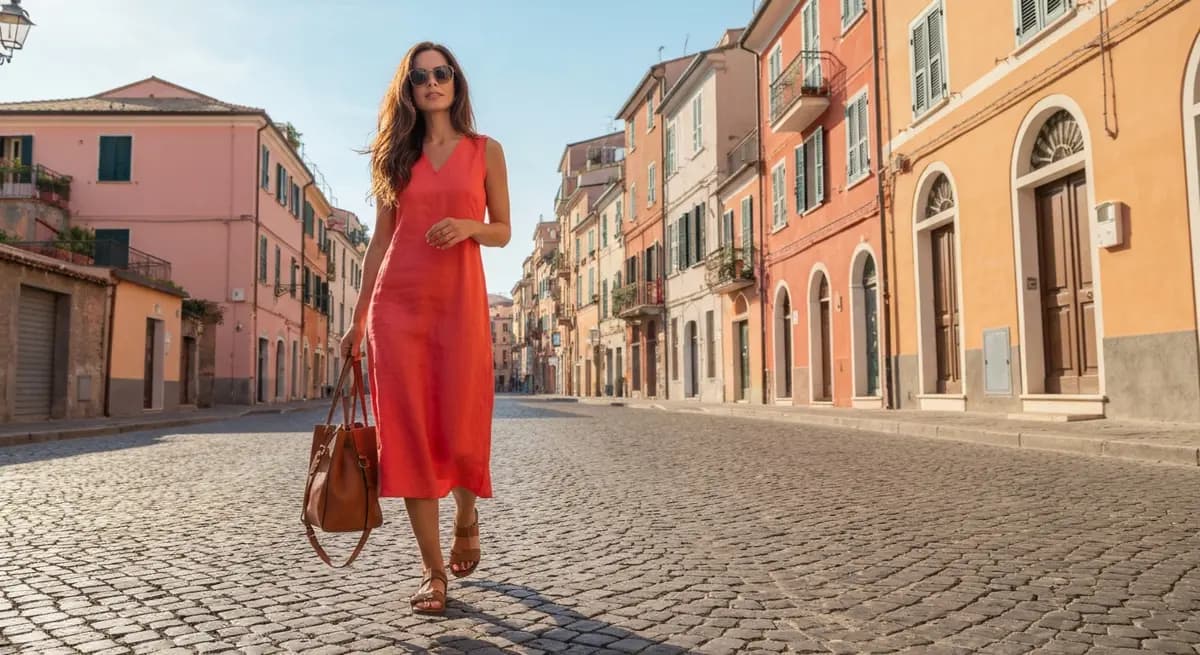
Italy has no official dress code, but it does have a calendar Italians dress by, a lot of uneven stone underfoot and church doors with guards who check your knees. Plan around those three things and the rest of the suitcase is easy.
What Italians Actually Wear Day to Day
Less than you'd think, and almost none of it is athletic.
Italians dress for the season on the calendar, not the number on the thermometer. Once October arrives, jackets and scarves come out even on a 22°C (72°F) afternoon, and they stay on until spring. A visitor in shorts and a tank top on a warm November day is the most noticeable person on the street, far more than someone in a slightly boring navy sweater.
The everyday look in Rome, Florence or Bologna is simpler than the stereotype: dark jeans or tailored trousers, a fine knit or a pressed shirt, leather sneakers or loafers, a proper jacket, and a scarf, worn by men as often as by women. Colors stay in the navy, grey, camel, olive, white and black range. None of it is especially dressy. It's clean, it fits, and it looks chosen.
A handful of items give visitors away faster than anything else. Here's what to swap:
| Tourist giveaway | What locals wear instead |
|---|---|
| Gym shorts, running tights, matching athleisure sets | Chinos, jeans or linen trousers; leggings only under a long knit or dress |
| Flip-flops in town | Leather sandals with a back strap, loafers, clean leather sneakers |
| Chunky running shoes in neon colors | Low-profile leather or suede sneakers in white, navy or tan |
| Big-logo or slogan tees, sports jerseys | Plain tees, knit polos, fine-gauge sweaters |
| Baseball cap | Sunglasses, or a straw hat in summer |
| Oversized daypack | A zip crossbody bag, worn in front on crowded buses and the metro |
Evenings are one small step up. Many people go home and change before dinner or the passeggiata, the slow early-evening stroll through the center, so the sneakers from the day become loafers and the tee becomes a shirt. For men, a navy knit polo or an overshirt does that job without a blazer.
What to Wear in Italy by Season
Fall is the wet one, winter is colder than the postcards, summer is hotter than you expect.
Italy is long, so the north and south can feel like different countries in the same week. The figures below are typical daytime highs for Rome. Take a few degrees off for Florence in winter, and more for Milan, Venice and anywhere near the Alps.
| Months | Typical weather in Rome | What to wear |
|---|---|---|
| September | Warm, highs around 27°C (81°F), cooler nights | Linen and cotton still work, plus a light jacket for the evening |
| October | Highs in the low 20s°C (low 70s°F), rain arrives | Knits, a trench or water-resistant jacket, closed shoes |
| November | The wettest month, highs around 17°C (63°F) | Rain jacket, ankle boots with grip, scarf, umbrella |
| December to February | Highs of 12 to 14°C (mid 50s°F), a few degrees above freezing at night; colder in the north | Wool coat, thin thermal layer, sweaters, waterproof boots |
| March to May | 16 to 24°C (60s to mid 70s°F), changeable | Light layers, a trench, sneakers or loafers |
| June to August | Highs around 31°C (88°F), heatwaves past 38°C (100°F) | Linen, cotton, sandals, a sun hat and something to cover your shoulders |
Fall (September to November): pack for rain, not cold
September is still summer in the south and on the coasts: linen works, and you'll want a light layer after sunset. By mid-October the rhythm changes. Rain comes in short, heavy bursts, and November is usually Rome's wettest month, which makes suede shoes and canvas sneakers a poor bet for the whole trip.
The fall outfit that works almost everywhere:
Dark straight jeans or wool trousers + a merino or cotton knit + a trench or unlined water-resistant jacket + a scarf + leather ankle boots or leather sneakers with rubber soles
A compact umbrella from home is worth the space. Street sellers show up near the big sights the minute it rains, but you'll pay for the convenience. For more combinations in the same palette, our fall outfit ideas use the layers you'd be packing for Italy anyway.
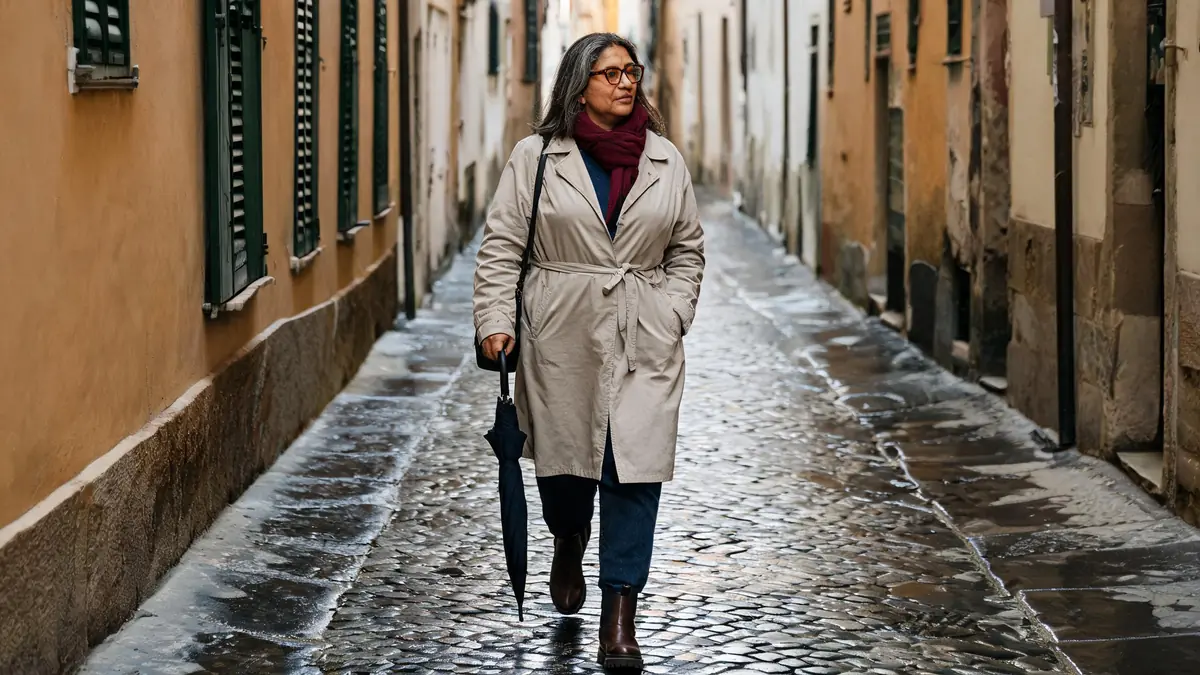
Winter (December to February): colder and greyer than the postcards
- Rome and Naples stay mild by day but damp, and old churches and museums are barely heated inside. A wool coat with a thin thermal top under your sweater covers both.
- Milan, Turin and Venice sit near or below freezing at night, with fog across the Po Valley. Add gloves, a hat and boots with real grip.
- The Dolomites and the Christmas markets in Bolzano and Merano are proper winter: a down coat, thermal leggings under trousers, and waterproof boots.
- Italians wear black, navy and camel coats all season, often with a bright scarf. A dark knee-length coat blends in anywhere.
Our winter outfit ideas go deeper on layering for city cold.
Summer (June to August): linen, shade and something for your shoulders
This is the season when tourists and Italians look most different. Locals wear linen trousers, cotton midi dresses, loose shirts and leather sandals; visitors wear gym shorts and sweat through polyester. Natural fibers genuinely help in 35°C heat, and linen creases are part of the look. The catch is the churches, which still expect covered shoulders and knees at 3 p.m. in August, so a large cotton scarf or a thin shirt stays in your bag.
Swimwear stays on the beach. Towns such as Sorrento and Venice fine people for walking around in swimsuits or bare-chested, and even where there's no rule, a cover-up dress or a shirt is expected in shops and cafés.
Spring (March to May)
Changeable is the word. A sunny 22°C afternoon can follow a 10°C morning, and April brings showers. A trench, a knit and something short-sleeved underneath will get you through Easter crowds in Rome or a May weekend on Lake Como.
Rome, Florence, Milan, Venice or Amalfi: Dress for the City
Rome
You'll walk more in Rome than you plan to, over sampietrini (dark basalt cobbles that are uneven when dry and slick when wet), and into churches you didn't mean to visit. Dress each morning as if you'll go into one, because you probably will. Evenings in Trastevere or Monti are relaxed: the jeans stay, the shoes and the top change.
Florence
The center is compact and flat, then climbs sharply to Piazzale Michelangelo and San Miniato al Monte, so soles with grip matter. Florence sits in a river basin, which makes it one of the hottest big cities in summer and damp and chilly in winter. The local palette leans warm: camel, olive, cream, rust. Every part of the Duomo complex checks shoulders and knees at the entrance.
Milan
Milan is the most dressed city in Italy and the easiest place to feel underdressed. Go darker and sharper than you would in Rome:
Black or navy tailored trousers + a fine knit or crisp shirt + a structured wool coat + minimal leather sneakers or loafers + one good leather bag
The women's fashion weeks run in February and September, and the whole center gets a notch smarter while they're on.
Venice
- Venice has more than 400 bridges, almost all with steps. Heels and roll-aboard cases both suffer.
- Acqua alta, the seasonal high tide, is most likely from October to January. The MOSE flood barriers now hold back the biggest tides, but St. Mark's Square is the lowest point in the city and can still take on water. Waterproof ankle boots, or the cheap plastic over-boots sold around town when it floods, solve it.
- Wind off the lagoon makes winter feel colder than the forecast, so a wool scarf earns its place from November to March.
Amalfi Coast
Positano, Amalfi and Ravello are built into cliffs, and getting anywhere means stairs. Flat sandals with a back strap or rubber-soled espadrilles beat slides and heels, and one pair of sneakers is worth packing if you plan to hike the Path of the Gods. Daytime is linen and cotton over swimwear; dinner is a small step up, like a midi dress, or linen trousers with a proper shirt. Ferries get windy, so bring a light layer even in July.
Church Dress Code in Italy: Vatican, Duomo and Every Chapel
The rule is the same almost everywhere, for men, women and children: shoulders covered, knees covered. The Vatican Museums' official visitor guidelines list sleeveless and low-cut tops, shorts above the knee, miniskirts and hats as not permitted, and St. Peter's Basilica applies the same standard at its security line. The Duomo in Milan, the Duomo complex in Florence and St. Mark's Basilica in Venice all check clothing at the door, and a paid ticket won't get you past a guard if your shoulders are bare.
What trips people up:
- Hemlines right at the knee. A skirt or shorts that just reach the kneecap standing still ride up on steps. Below the knee is safe.
- Assuming it's a women's rule. Men in shorts above the knee get turned back too.
- Sheer, mesh or cut-out tops, which don't count as covered even with sleeves.
- Small parish churches. There's rarely a guard, but the same courtesy applies, and if Mass is on, stay at the back and keep quiet.
The easy fix is a large cotton or linen scarf in your day bag: it goes over the shoulders or ties at the waist as a wrap skirt. Men who like shorts in summer can carry a pair of light drawstring trousers. Our guide on what to wear to church covers the same modesty logic for services at home.
The rule: if your day includes a historic center, dress for a church that morning. You'll end up walking into one you didn't plan to visit.
Shoes for Cobblestones (and the Pairs to Leave Home)
Italian streets are hard on feet and harder on shoes. Rome's basalt cobbles are uneven, Florence's paving stones are worn smooth, Venice has steps every few minutes and the Amalfi Coast is one long staircase. What works:
- Leather sneakers or loafers with a cushioned rubber sole for most days, in white, tan or navy, low profile, no neon.
- Ankle boots with a low block heel and rubber tread from October to March. They handle rain and keep jeans hems dry.
- Leather sandals with a back strap or a cushioned footbed in summer. Footbed sandals are common on Italian streets, so you won't stand out in them.
- Proper trail shoes only if you're hiking the Cinque Terre paths or the Dolomites.
Leave behind stilettos (they catch in the gaps), thin-soled ballet flats (you'll feel every stone by lunch), flip-flops (slippery on marble and wet stone) and anything you haven't worn for a full day at home. Two pairs that rotate beat three that don't, because leather needs a day to dry out after rain.
Italy Packing List for One to Two Weeks
This list is built for fall and winter, since that's the trip most people are packing for right now. The summer swaps follow.
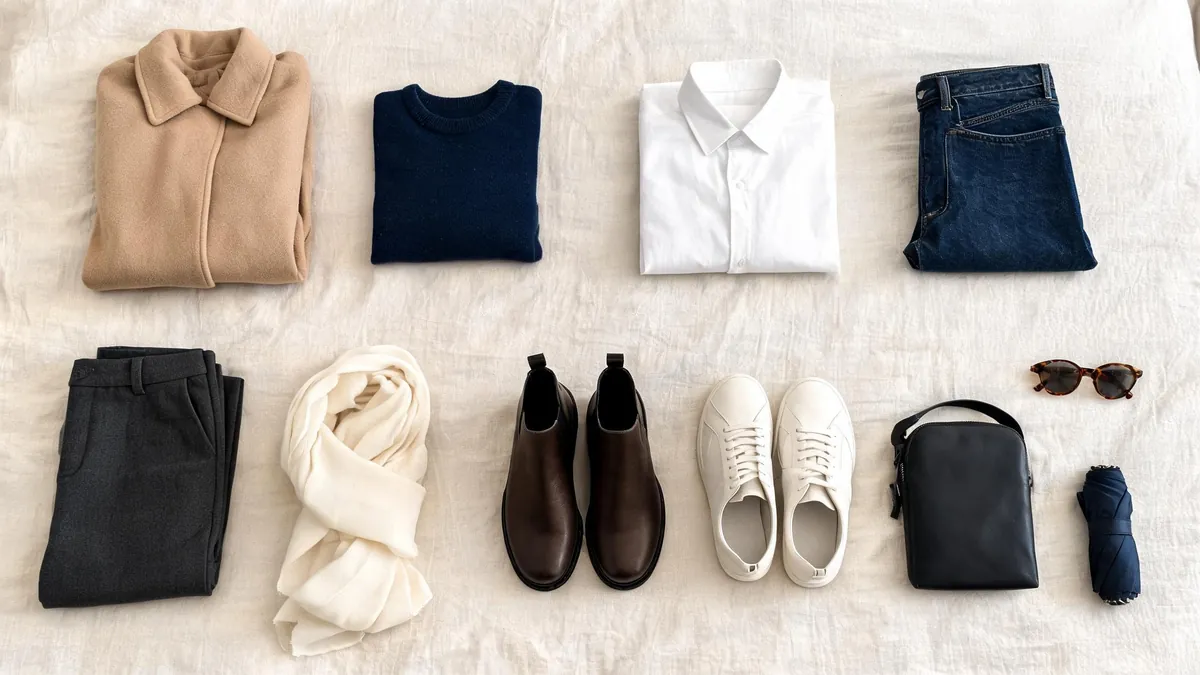
- Two bottoms: dark straight jeans and wool or tailored trousers
- Three tops: a white poplin shirt, a plain tee and a fine-knit long-sleeve
- One warm knit in navy, grey or camel
- One midi dress or skirt that works for dinner and is church-ready
- One coat: a trench for September and October, wool from November
- One large scarf for warmth, church cover and an instant outfit change
- Leather sneakers or loafers with rubber soles
- Ankle boots with grip
- A crossbody bag that closes with a zip
- A compact umbrella, plus a thin thermal layer if you're going north
For summer, swap the coat and boots for linen trousers, a cotton midi dress, leather sandals and a sun hat, and keep the scarf.
Build everything around two or three neutrals so every top works with every bottom, the same idea behind a capsule wardrobe. If you'd like to check the combinations before you zip the case, you can plan looks from the clothes you already own in Klodsy, the way our guide to planning vacation outfits walks through.
If Italy is one stop on a longer trip, the guides to what to wear in Spain and what to wear in Paris follow the same season-by-season approach. And when the suitcase is nearly done, try Klodsy to see your Rome-to-Milan outfits on your own photo before you fly.
Related Articles
What to Wear in London: Style Guide for Visitors 2026
What to wear in London by season and neighborhood. Covers the London uniform, Tube tips, packing list, tourist mistakes to avoid, and outfit formulas.
Airport Outfit Ideas: What to Wear for Comfort and Style
Discover the best airport outfit ideas for every season. TSA-friendly tips, layering tricks, and outfit formulas for comfortable, stylish travel.
What to Wear in Paris: Style Guide for Every Season
Plan what to wear in Paris with our seasonal style guide. Parisian outfit ideas, restaurant dress codes, and French fashion rules every traveler needs.
Frequently Asked Questions
Everything you need to know about this topic
Layers and rain gear: dark jeans or wool trousers, a knit, a trench or water-resistant jacket, a scarf, and leather shoes or ankle boots with rubber soles. Afternoons can be warm, but rainy days and evenings feel cool.