
Smart Casual vs Business Casual: The Definitive Guide
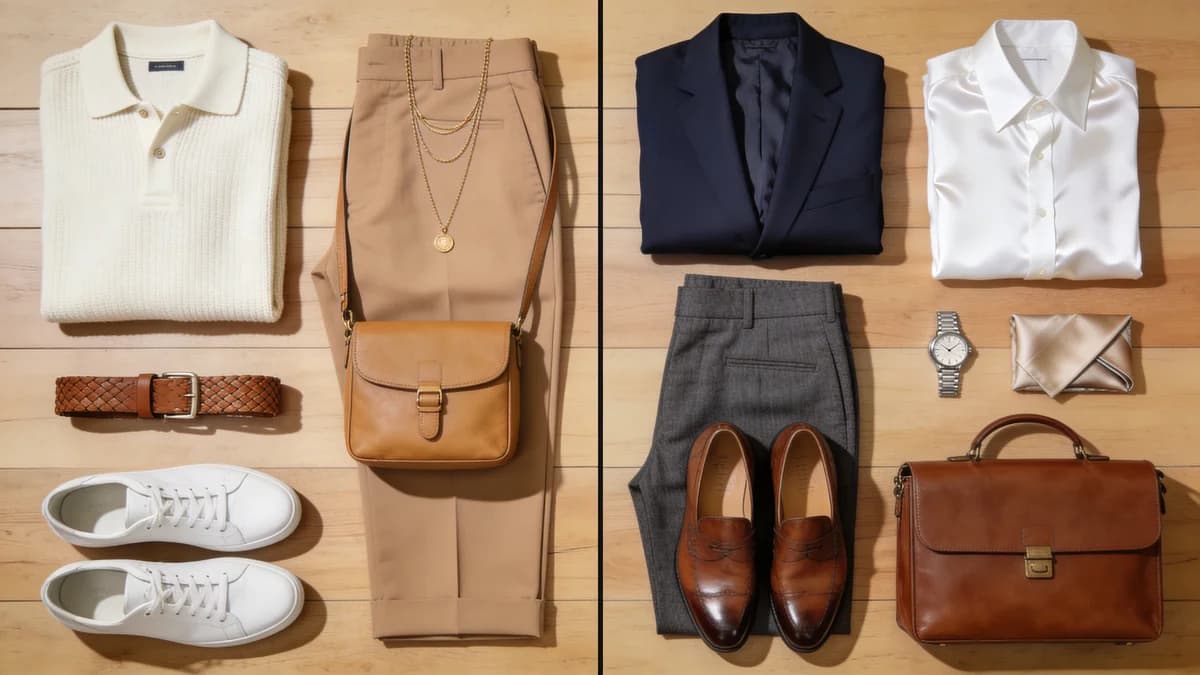
Smart Casual vs Business Casual: Which One Did They Mean?
You got an invite (or a memo) and now you're stuck. Smart casual and business casual sound interchangeable, but they aren't. The fastest answer: business casual is office-formal relaxed; smart casual is casual elevated. Business casual starts from a suit and removes the tie. Smart casual starts from your weekend outfit and adds one structured piece. Business casual lives at work. Smart casual lives everywhere else (and increasingly, at work too).
That single distinction decides whether dark jeans are fine, whether clean sneakers fly, and whether a polo counts. The rest of this guide walks through what each dress code actually means in 2026, what men and women wear for each one, how to read mixed-signal invitations, and the specific mistakes that get people pulled aside by HR or quietly judged at a dinner.
Need the elevated end of casual on its own? Our smart casual outfit ideas guide goes deeper into the casual-leaning side. If you're hunting for office formulas specifically, the office outfit ideas guide breaks it down by industry.
The Quick Definitions (And Where They Came From)
Business casual showed up first. The phrase started traveling through US corporate offices in the 1960s and went mainstream in the 1990s when Friday "dress-down" days bled into the rest of the week. It was a compromise: the suit had to give a little, but workplaces still wanted a clear professional baseline. So the tie disappeared, the jacket became optional, and a button-down replaced the dress shirt. The trousers stayed. The leather shoes stayed.
Smart casual came up through the 2000s and 2010s as a social dress code first, a workplace one second. It was the answer to "we're going somewhere nice, but not formal." Restaurants used it. Galleries used it. Then tech offices and creative agencies started adopting it as their daily standard, and now it's possibly the most common dress code term you'll see on event invites.
The result: business casual is mostly a workplace term, smart casual is mostly a lifestyle term, and they overlap in the middle.
Business Casual at a Glance
- Built down from a suit
- Jeans usually not allowed
- Sneakers usually not allowed
- Tie optional but blazer often implied
- Reads "professional"
Smart Casual at a Glance
- Built up from weekend wear
- Dark jeans welcome
- Clean leather sneakers welcome
- Tie almost never, blazer optional
- Reads "intentional"
The Comparison Table You Came Here For
Here's the side-by-side. This is the centerpiece of the whole article. Print it, screenshot it, or memorize it.
| Element | Business Casual | Smart Casual |
|---|---|---|
| Origin | Workplace, US 1990s | Social/lifestyle, 2000s |
| Mindset | Take a suit, relax it | Take casual, elevate it |
| Trousers | Dress trousers, chinos | Tailored trousers, dark jeans, chinos |
| Denim | Generally no | Yes, dark wash, well-fitting |
| Tops (men) | Collared shirt, sometimes polo | Polo, henley, quality tee, button-down |
| Tops (women) | Blouse, silk shirt, fine knit | Knit top, silk camisole, quality tee, blouse |
| Footwear | Leather loafers, oxfords, low heels, flats | Leather sneakers, loafers, ankle boots, mules |
| Sneakers | Generally no | Yes, clean leather/canvas |
| Jacket | Blazer often expected | Blazer optional, denim/chore jackets fine |
| Tie | Optional, rare today | Almost never |
| Accessories | Conservative, leather belt, watch | Personal style allowed, statement piece OK |
| Color palette | Navy, charcoal, white, beige, burgundy | Wider range including earth tones and pastels |
| Setting | Office, business dinner, networking | Restaurant, weekend event, creative office |
| One-line test | Could you stand next to a CEO? | Could you walk into a nice restaurant? |
Notice the overlap in the middle. Tailored trousers + a fine knit + loafers works for both. That's not a coincidence. When you're unsure which dress code applies, the middle ground covers you for either.
The Five Questions That Settle It
When the invite is ambiguous, run through these five questions. Each one nudges you toward business casual or smart casual.
- Is denim allowed? If yes, you're in smart casual territory. If no, business casual.
- Are clean sneakers acceptable? If yes, smart casual. If no, business casual.
- Is the venue an office or a social space? Office leans business casual. Restaurant, bar, gallery, or event leans smart casual.
- Is leadership going to be there? If a CEO, board member, or client is in the room, dress one notch up. Business casual usually wins.
- What did you wear there last time? Sounds obvious, but it's the most reliable signal. Match the room.
If three answers point one way, that's your dress code.
Smart Casual vs Business Casual for Men
Men's wardrobes have fewer variables, which actually makes the dress code distinction easier. The real question is what you put on the bottom and what you put on your feet. Everything else follows.
Men's Business Casual Core
The reliable men's business casual outfit hasn't changed much in twenty years. Chinos or dress trousers in navy, gray, or stone. A button-down in white, light blue, or a quiet check pattern. Leather loafers or oxfords. Belt that matches the shoes. Optional unstructured blazer when meetings or clients are involved. No tie required, but you should be able to add one if the day shifts formal.
A polo can work if it's a quality knit polo (think mercerized cotton or fine merino) in a muted color. Avoid sport polos with embroidered logos, which read country club rather than corporate.
Men's Smart Casual Core
Same chinos work here, but now dark, well-fitting jeans are equally valid. The shirt loosens up: an untucked oxford, a henley, a polo, a quality tee under a blazer. The shoes change the most. Clean leather sneakers in white or off-white become acceptable, along with suede desert boots, loafers, and Chelsea boots.
The blazer goes from "often expected" to "optional accent." A denim jacket, chore coat, or unstructured cotton blazer all read smart casual when paired correctly. For more ideas on building this side of your wardrobe, the men's wear guide covers foundational pieces in detail.
Side-by-Side Outfit Examples (Men)
Business casual for a Tuesday at the office: Navy chinos + white oxford button-down + brown leather loafers + leather belt + simple watch.
Smart casual for the same Tuesday at a creative agency: Dark slim jeans + navy crewneck merino sweater over a white tee + clean white leather sneakers + leather belt.
Same person, same temperature, two different dress codes. The trousers and shoes do almost all of the signaling.
Smart Casual vs Business Casual for Women
Women have more pieces to work with, which is both an advantage and a complication. The categories overlap more, but the boundaries still exist.
Women's Business Casual Core
The dependable formula: tailored trousers, pencil skirt, or knee-length dress + blouse, silk shirt, or fine-gauge knit + leather loafers, low heels, or pointed flats + structured bag. Blazer is often the deciding piece. Add it for meetings, client lunches, or anywhere stakes are higher.
Denim is generally off the table for traditional business casual workplaces, though more permissive offices are quietly allowing dark, tailored jeans on certain days. When in doubt, ask, or wear trousers the first month.
Women's Smart Casual Core
Same trousers count, but now dark jeans, midi skirts in softer fabrics, and knit dresses all enter the rotation. Tops loosen: a quality tee under a blazer, a tucked-in knit, a silk camisole, a relaxed silk shirt. Shoes expand dramatically. Clean leather sneakers, mules, ankle boots, ballet flats, kitten heels, even a chunky loafer all work as long as they look intentional.
The blazer goes from "professional anchor" to "one of many optional layers." A leather jacket, a denim jacket, a trench, or a cardigan can all replace it depending on the season.
Side-by-Side Outfit Examples (Women)
Business casual for a Wednesday at a law firm: Charcoal tailored trousers + white silk blouse + black leather loafers + structured tote + minimal gold studs.
Smart casual for a Wednesday at a marketing agency: Dark straight-leg jeans + cream knit top + camel blazer + clean white leather sneakers + crossbody bag.
For more outfit pairings around denim specifically, see our what to wear with jeans guide. For trouser-led looks, what to wear with black pants covers business casual and smart casual options in the same closet.
What to Wear By Setting
Different rooms ask different questions. Here's how to read each setting.
Tech Office vs Finance Office
A tech office is almost always smart casual, sometimes leaning toward fully casual. Dark jeans, clean sneakers, knit tops, and one structured layer get you through 90% of days. A finance office is business casual at minimum, often with formal Tuesdays through Thursdays. Trousers, leather shoes, button-downs (or blouses), and a blazer within reach.
If you're switching industries, the dress code adjustment can take a month. I moved from a magazine office to a fintech client meeting and underdressed in dark jeans and a knit polo. Everyone else had blazers. The lesson: research the office before you go, or just default to business casual when you don't know.
Networking Event
Networking events use "smart casual" as the default but skew toward the dressier end of it. Tailored trousers or dark jeans + a polished top + a blazer + loafers or clean leather shoes. A blazer is the single best investment for networking because it photographs well and signals effort without overdoing it.
Dinner With Your Boss
Smart casual, but lean polished. Dark jeans are fine; sneakers are usually a step too casual unless you've worked at the company long enough to know the boss wears them too. Pick a knit or blouse over a tee. Add a blazer or a tailored layer. Leather shoes or boots over canvas.
First Day at a New Job
Default to business casual on day one even if the offer letter said smart casual. You'll be more comfortable looking slightly overdressed than slightly underdressed, and you can downshift by the second week. This rule applies across industries.
Conference
Conferences split by industry. A tech conference is smart casual heaven; jeans, knits, sneakers, and one branded layer dominate. A finance or legal conference is business casual at a minimum, often with formal evening sessions requiring a blazer or cocktail attire. Read the agenda before you pack.
When the Invite Says One Thing and the Venue Says Another
This is the trickiest scenario. The invitation says "smart casual" but the venue is a steakhouse with white tablecloths. Or the dress code says "business casual" but everyone you know who works there shows up in dark jeans.
The rule: trust the venue over the invitation. The room sets the tone more than the words on the invite do. A white-tablecloth restaurant pulls everyone toward the dressier end of smart casual whether the host wrote "smart casual" or "business casual." A coworking space pulls everyone toward the softer end of business casual regardless of what HR wrote in the employee handbook.
If you can't visit the venue ahead of time, look up photos on the venue's website or Instagram. Three minutes of research saves an hour of outfit anxiety.
The Classic Mistakes (And How to Sidestep Them)
Business Casual Mistakes
Wearing the full suit. Suits with no tie are still suits. Business casual means a step down. A blazer with contrasting trousers, or trousers and a button-down with no jacket, are both safer.
Athletic shoes in any form. Even clean running shoes register as athletic, not professional. If your shoes have visible mesh, they don't belong in business casual.
Wrinkled fabrics. Business casual depends on garment condition more than smart casual does. A wrinkled button-down ruins the whole outfit. Steam everything before wearing.
Cargo or technical pants. Cargo trousers, joggers, and outdoor/technical fabrics don't translate to business casual no matter how nicely they're cut. Save those for weekends or pair with a more relaxed setting using our cargo pants styling guide.
Smart Casual Mistakes
Going head-to-toe casual. A tee, jeans, and sneakers is casual, not smart casual. You need at least one structured piece. Add a blazer, swap the tee for a knit, or trade sneakers for loafers.
Overcorrecting into business formal. A full suit at a smart casual dinner reads as if you didn't read the invitation. Smart casual has more flexibility than business casual, but the top end is still relaxed.
Worn-out denim or sneakers. Smart casual lets denim and sneakers in, but only if they look intentional. Faded jeans, scuffed sneakers, or anything that screams "weekend chores" breaks the dress code.
Too many statement pieces. Smart casual is about subtle polish, not visual noise. One bold piece per outfit, max.
Accessory Rules, Side by Side
Accessories often decide which side of the dress code line your outfit falls on.
Watches: Both dress codes accept watches. Business casual leans toward leather straps and clean dials. Smart casual is more flexible (a steel sport watch is fine).
Belts: Leather belts match the shoes for both. Woven, suede, or fabric belts read smart casual.
Bags: Structured leather bags work for both. Canvas totes, crossbodies, and backpacks lean smart casual.
Jewelry: Business casual stays minimal (small studs, simple chain, one ring). Smart casual allows layered necklaces, stacked rings, statement earrings, and bolder pieces.
Eyewear: Both accept polished frames. Sport sunglasses or mirrored aviators tip into smart casual.
Fabric and Color: The Quiet Signals
Fabric quality and color palette do more dress code work than people realize.
Business casual fabrics lean toward worsted wool, cotton poplin, fine knit, silk, and structured cotton. The look is crisp and holds shape.
Smart casual fabrics open up to merino, cashmere, heavier knits, denim, linen, jersey, suede, and leather. The look has more texture and softness.
Business casual colors stay in a narrower band: navy, charcoal, gray, white, light blue, beige, burgundy, and occasional muted patterns (small checks, fine stripes).
Smart casual colors include all of the above plus earth tones (rust, olive, terracotta, sage), softer pastels, and even subtle prints. A patterned blazer reads smart casual where the same cut in solid navy would read business casual.
For a more minimalist take on building a wardrobe that floats between both, our minimalist style guide is worth a read.
Quick-Reference Outfit Formulas
Three formulas per category. Copy them as-is or treat them as starting templates.
Men's business casual: Navy chinos + light blue button-down + brown leather loafers + brown leather belt + minimal watch.
Men's business casual (winter): Gray wool trousers + white button-down + navy fine-gauge merino crewneck + brown leather Chelsea boots.
Men's business casual (summer): Stone chinos + white short-sleeve button-down (untucked optional in casual offices) + brown leather loafers (no socks visible).
Men's smart casual: Dark slim jeans + crewneck merino over white tee + clean white leather sneakers + leather belt.
Men's smart casual (winter): Dark jeans + charcoal turtleneck + unstructured navy blazer + brown suede Chelsea boots.
Men's smart casual (summer): Stone chinos + linen camp-collar shirt + canvas or leather sneakers + leather belt.
Women's business casual: Charcoal tailored trousers + white silk blouse + black leather loafers + structured tote + small stud earrings.
Women's business casual (winter): Navy tailored trousers + cream merino crewneck + camel coat + black ankle boots + structured leather bag.
Women's business casual (summer): Cream linen-blend trousers + silk camisole + structured blazer (carry, don't always wear) + pointed flats.
Women's smart casual: Dark straight-leg jeans + tucked-in knit top + camel blazer + clean white leather sneakers + crossbody bag.
Women's smart casual (winter): Wide-leg trousers + chunky knit + leather jacket + ankle boots + layered necklaces.
Women's smart casual (summer): Midi dress in a soft solid + leather belt + suede mules + simple structured bag.
So Which One Should You Wear?
Run the five questions, look at the venue, ask one person if you can. When stakes are high (first day, a major dinner, a client meeting), default up. When stakes are normal and you'd rather feel like yourself, default to smart casual with one polished anchor piece.
Tools like Klodsy can help when you want to see a combination on yourself before you commit to it (especially useful for the awkward "smart casual but make it boss-appropriate" days where the right answer isn't obvious). You can try outfits virtually from your existing closet and compare a blazer-and-loafer version against a knit-and-sneaker version side by side.
A small reminder that closes everything out: the goal isn't to get the dress code "right" in some absolute sense. It's to match the room well enough that nobody notices your outfit, and instead notices you. Both smart casual and business casual are tools for doing exactly that. The trick is knowing which tool the room is asking for.
If you have a high-stakes event coming up, our interview outfit guide covers the dressier end, and the formal outfit and dress code guide takes you all the way up to black tie. Try Klodsy free to test smart casual and business casual combinations from your own closet before the day arrives.
Related Articles
Jumpsuit Outfits: 20 Looks From Work to Wedding Guest
Jumpsuit outfits for every occasion: 20 ways to style one for work, weekends and weddings, plus how to fix the fit, the length and the bathroom problem.
Blazer Outfits: 20 Looks That Aren't Just for the Office
Blazer outfits for every season: 20 ways to wear one with jeans, dresses and trousers, from work meetings to dinner. No corporate stiffness required.
How to Wear a Polo Shirt (Men's Guide)
How to wear a polo shirt the right way. Fit, tuck rules, what to pair it with, and what to wear over it, so a polo reads smart casual instead of sloppy.
Frequently Asked Questions
Everything you need to know about this topic
Business casual is office formality relaxed one notch (no tie, but still collared shirts, dress trousers, and leather shoes). Smart casual is everyday casual elevated one notch (dark jeans and clean sneakers are allowed, as long as one structured piece anchors the look). Business casual starts from the suit and removes; smart casual starts from the weekend and adds.