
What Not to Wear in 2026: 15 Style Mistakes to Avoid
The Five Categories Most Outfits Fail In
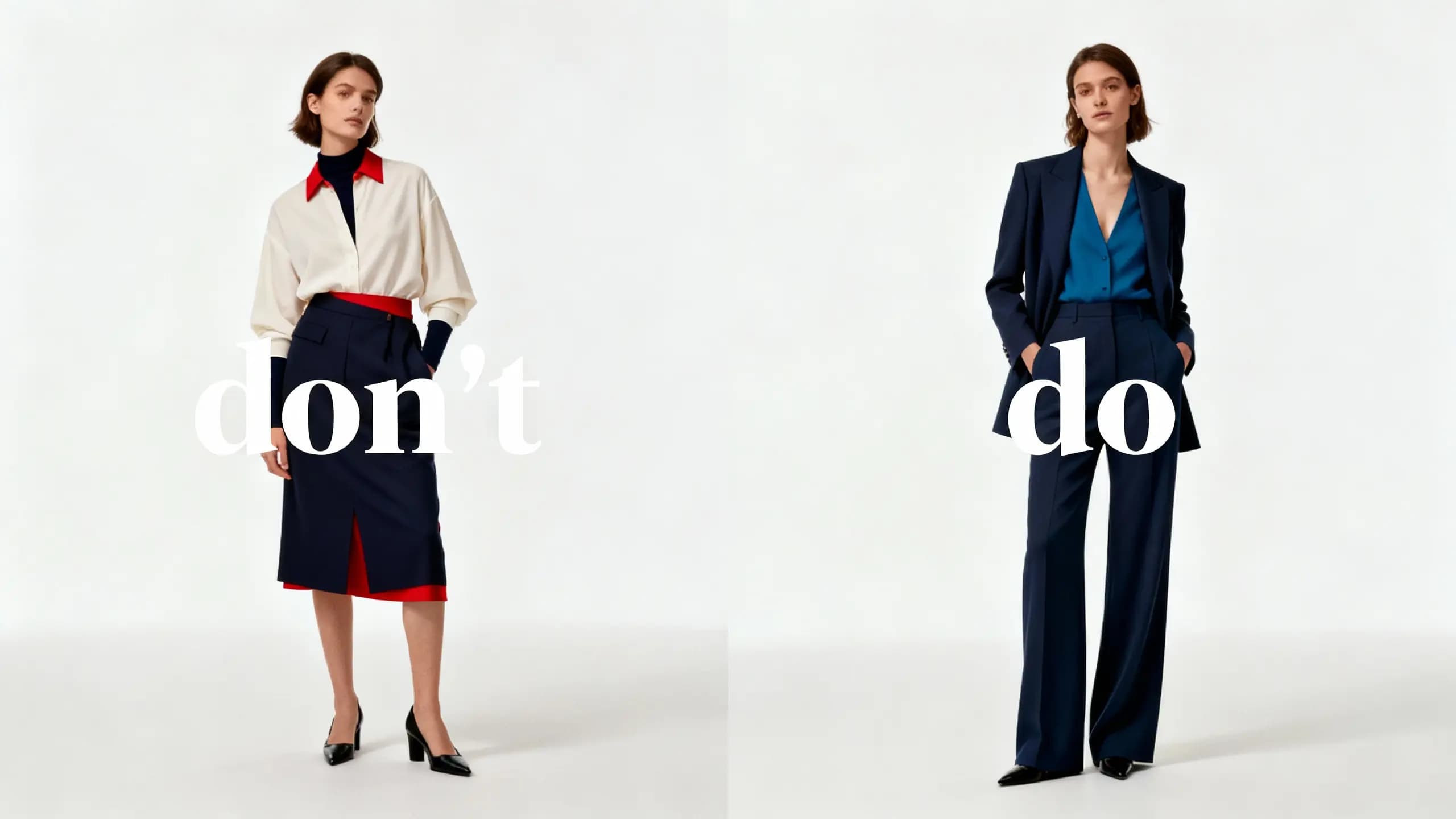
Most outfits don't fail on style choices. They fail on one avoidable detail: wrong fit, clashing color, wrong setting, dated trend, or a piece that's quietly worn out. These 15 mistakes group into five categories: fit, pattern and color, occasion, trend timing, and maintenance. The same fix often resolves several at once (better fit alone solves three). Below: every mistake with the one-line fix, organized by category.
How to Use This List
You don't need to read all five categories if you already know your weak spots. Pick the sections that match where your outfits tend to fall apart. Better fit solves three of these mistakes. Editing accessories down solves two more.
Category 1: Fit Mistakes
Where most outfits actually fall apart, before anyone notices anything else.
Fit is the single biggest factor in whether an outfit looks like you meant it.
| Mistake | What it looks like | Why it kills the outfit |
|---|---|---|
| #1 Wrong shoulder fit | Seam falls past your shoulder bone, jacket looks oversized in a bad way | Distorts all proportions, makes everything underneath look sloppy |
| #2 Too-long sleeves | Cuffs hide your hand, bunch at the wrist | Reads as borrowed or hand-me-down regardless of the brand |
| #3 Bad pant break | Excess fabric pools at the ankle, or hem rides too high | Cuts the leg line awkwardly and creates confusion with shoe choice |
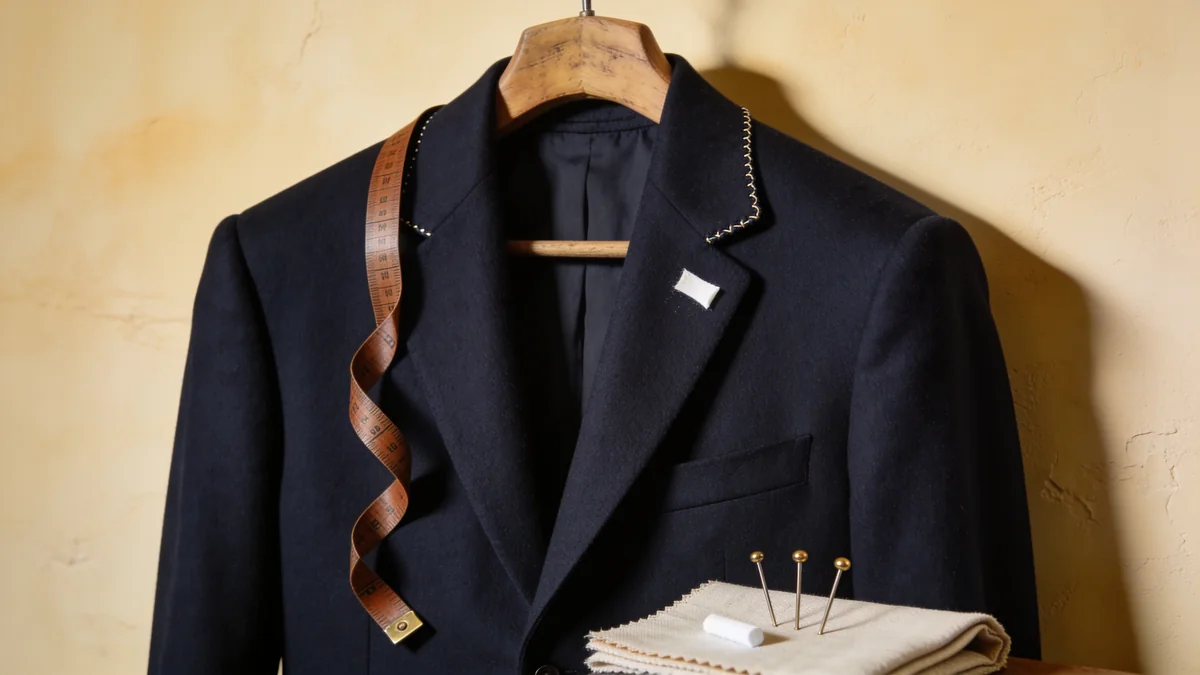
Most fit problems are solved for $15 to $40 per piece at any tailor. That's not a luxury spend. It's the cheapest upgrade available in fashion, and people skip it because it feels like extra effort after already buying something.
Off-the-rack patterns are cut for a statistical average that doesn't actually describe most bodies. A jacket might fit your chest perfectly and still be two inches too long in the sleeve. That's not a body problem, it's a pattern problem, and a tailor fixes it in ten minutes.
If you want to explore how to dress better starting from fit, shoulder seam position is always the first thing to check.
Brands that tend to do better on off-the-rack fit: J.Crew runs consistent across sizes, Suitsupply offers in-house tailoring at good value, Theory cuts slim and clean, Madewell's denim fits a wider range of bodies than most. These aren't guarantees, but they're better starting points than fast fashion sizing.
The fix: A $20 tailor visit outperforms a $200 new piece, every time.
A common pattern: clothes that are technically your size look fine in the dressing room and wrong everywhere else. Very often the cause is the shoulder seam sitting a centimeter past the bone, and one tailor visit fixes it.
Category 2: Pattern and Color Clashes
Three moments where the wrong combination read as accidental rather than bold.
Pattern and color mistakes happen at decision time, not in front of the mirror. By the time you're checking the mirror, you've already committed to the combination. That's where most people go wrong.
#4 The "Too Many Patterns" Outfit
It's Saturday morning. You pull on a striped shirt because stripes are easy, then add a floral midi skirt because it was the first bottom you saw. Then you realize the tote bag has its own geometric print on it.
Three patterns competing means no single pattern wins, and the outfit reads as accidental rather than confident. The rule of thumb that actually works: one print per outfit, supported by solids. Two prints can coexist, but only when the scales differ dramatically.
A large floral with a thin pinstripe can work. A medium floral with a medium stripe fights. If you're building a smart casual outfit from scratch, start with one print and let everything else be a solid before experimenting further.
#5 The Color Wheel Crash
You're getting dressed for dinner. You pair a fuchsia blouse with a mustard skirt because both are colors you love separately. The result reads loud, not bold.
Bold means deliberate: cobalt blue with camel and cream, for example, creates tension that resolves. Loud means unplanned, and people feel the difference even when they can't name it.
The fix isn't avoiding color. Color is worth wearing. It's understanding which combinations create productive tension and which just argue with each other. Complementary colors work, while colors at similar saturation levels that aren't intentionally contrasting often don't.
#6 Wearing Colors That Wash You Out
Most "this outfit just doesn't look right" feelings are actually wrong-color-for-skin-tone feelings in disguise. Cool undertones often go flat in warm yellow. Warm undertones can look dull in icy blue.
The right neutral for your skin changes everything: cream versus bright white, charcoal versus jet black, camel versus khaki. These aren't dramatic swaps, but the difference between looking alive in your clothes and looking drained by them is real. A five-minute experiment in natural light, holding different fabrics near your face, tells you more than any color theory chart.
If you want a structured approach to this, AI color analysis is a faster starting point than trial and error in store lighting.
Color rule: One print per outfit. Two only if scales differ dramatically.
Category 3: Occasion and Context Mistakes
The kind of mistake that gets noticed within the first ten seconds.
Occasion mismatches are the most visible mistakes on this list. People notice underdressing faster than they notice almost anything else, and the read sticks.
#7 Athleisure in Business Settings
Yoga pants and a structured top is not business casual. Even in tech offices where the dress code is genuinely relaxed, there's a category called "intentional clothing" that athletic wear doesn't reach. It reads as either heading to the gym after or having just rolled out of bed.
Joggers with a blazer occupy a gray zone that only works if the fabrication and fit are both excellent, and most of the time they're not. The line isn't about formality. It's about whether the pieces look like they were chosen for this specific day.
#8 Beachwear Off the Beach
Slides, bikini tops worn as crop tops, and cover-ups treated as dresses work on the beach. Five minutes from the water, in a restaurant or a shop, the dress code shifts and the same clothes shift meaning.
This isn't about being overdressed everywhere. It's about recognizing that context changes what clothes communicate, and beachwear in non-beach settings reads as either unaware or uninterested in where you are.
#9 Underdressing for Smart Casual
Smart casual is not "casual." A t-shirt and jeans rarely cross the smart casual threshold on their own, even well-fitting ones. Adding one structured element changes that completely: a blazer over a clean tee, a leather loafer instead of a sneaker, a quality knit instead of a crewneck sweatshirt. The base can stay casual.
The finish has to be intentional. You can find combinations that actually work in the what to wear today guide, which covers this gap specifically.
For any dress code you're uncertain about, the rule holds: dress one notch above what you think is expected. Showing up slightly overdressed is forgivable and often reads as respect for the occasion. Showing up underdressed is harder to walk back from.
Occasion rule: When in doubt, dress one notch above what you expect.
Category 4: Trend and Time Mistakes
Three places where 2010s rules quietly stopped working without anyone announcing it.
Not every trend is wrong, and not every classic stays. Some rules from the 2010s are actively outdated in 2026. Here's where people tend to get the era right or wrong.
#10 Holding Onto Skinny Jeans as the Default
"Wait, are skinny jeans out?" Not entirely. They're no longer the default cut, though. Straight-leg, wide-leg, and slim-straight dominate 2026 denim.
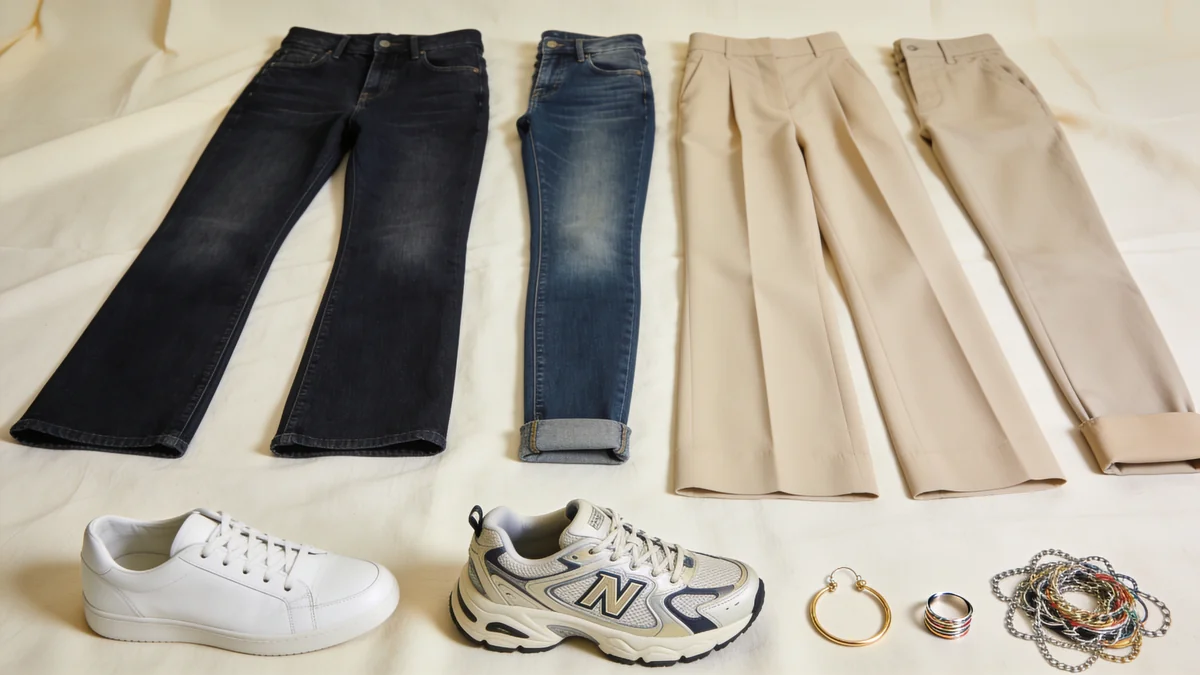
Skinny jeans still work in specific contexts: tucked into tall boots, worn under long coats, or styled with an oversized layer. The mistake is having a jean drawer that's 70% skinny and treating it as a neutral starting point the way people did in 2015. Levi's 501s, A.P.C. Petit New Standards, and Madewell's straight cuts are where most wardrobes are landing right now.
Pro tip: If your jeans drawer is more than 70% skinny, add one straight or wide-leg cut before buying anything else, that single addition opens more outfit combinations than replacing five other pieces.
#11 Avoiding Low-Rise When It's Actually Back
"I thought low-rise was a 2000s mistake?" It was, then it returned. Modern low-rise sits at the hip without the uncomfortable cut of Y2K super-low styles. The fashion mistake now works in both directions: wearing extremely low-rise like it's 2003, or refusing to try any low-rise at all because of one bad memory from that era.
The current version pairs well with a longer top or a fitted knit. It doesn't work with a cropped tee that gaps at the waist and shows everything. Knowing the body type guide helps here if you're figuring out how low-rise sits on your frame.
#12 Logo Maximalism Without Context
"Logos are fine in streetwear, right?" Context is everything. A single discreet logo reads as taste: a small Polo on a rugby shirt, a tonal Lacoste on a polo, a faint Stüssy script on a tee. Head-to-toe monogram prints, or counterfeit-looking logo stacks from fast fashion, read as either trying too hard or just off.
Quiet luxury has been the dominant mood from 2024 through 2026, which means visible branding reads louder than it used to, not in a good way. COS, Sezane, and A.P.C. built their current relevance on exactly this shift.
Trend filter: Adopt one trend piece per season. Skip head-to-toe trend dressing.
Category 5: Maintenance and Detail Mistakes
Tiny failures that compound, and undo good outfits without anyone naming what's off.
A great outfit with a small flaw looks worse than a simple outfit done right. The flaws compound. The simplicity carries.
#13 Wrinkles and Worn-Out Basics
Two minutes with an iron or a steamer changes how a shirt reads from five feet away. A white tee that's lost its shape after 40 washes is not the same garment it was when you bought it, even if it once cost the same as the one you're about to buy to replace it.
Basics fade. They stretch out at the collar, they yellow subtly, they lose their crispness. The fix is quiet and cheap: replace them before they start dragging the rest of the outfit down.
The cost of a $15 replacement tee is less than the cost of one day spent feeling slightly off because the foundation piece wasn't doing its job.
#14 Scuffed Shoes
People notice shoes before they consciously register that they're looking at them. A polished pair of brown leather loafers carries an entire smart casual outfit. The same outfit with scuffed soles and cracked leather drops two notches immediately.
A brush, some polish, and a buffing cloth take five minutes. A damp cloth takes two. Neither is a commitment.
Scuffed shoes are almost always a habit problem, not a resource problem. The shoes are usually fixable. Most people just don't get to them until after the occasion has passed.
Pro tip: Keep a cloth and a small tin of neutral polish on the same shelf as your shoes, not in a drawer somewhere else. Proximity is what turns this from a chore into a 90-second habit.
#15 Over-Accessorizing
This one has gotten worse recently because social media algorithms push layered necklaces and stacked rings as the default look. The underlying rule still holds: one statement piece per outfit, supported by quiet pieces. A thick silver cuff plus a chain necklace plus three rings plus statement earrings is four pieces competing for the same square foot of attention.
Pick the loudest one. Mute the rest. The outfit settles, and the piece you chose to highlight actually lands.
Swapping a heavy cuff for a thin watch while keeping a striking necklace is often enough for the whole outfit to reorganize itself around that one edit.
A capsule wardrobe built on this principle, where accessories are deliberate rather than accumulated, tends to outlast trend cycles. The capsule wardrobe guide covers the accessory editing principle in more depth.
Maintenance rule: Two minutes with an iron beats buying a replacement shirt.
The One Rule That Solves Most of It
The single habit that prevents almost everything above.
Spend the same amount of time checking the outfit before you leave as you spent choosing the individual pieces when you bought them. That's not a long time. It's a full-length mirror, a look at the back, a check of the shoes, and a quick scan for anything that pulls, gaps, or fights with the rest of the outfit.
Two minutes. Most style mistakes survive because nobody caught them before walking out the door. The mirror catches almost all of them if you actually use it.
The outfit you thought was fine at 7 a.m. in dim light is not always the outfit you're wearing at 10 a.m. in an office or a cafe. A few seconds of honest assessment closes that gap almost every time.
The 15 mistakes above cover most of what goes wrong between "looks fine" and "looks good." Fit is the biggest lever. Color takes the most practice. Occasion awareness comes from paying attention to where you are and who's there.
Maintenance is just habit. None of it requires buying more. Most of it requires buying less, but better, and caring for what you already have. Try Klodsy to test outfit combinations from your existing wardrobe before stepping out the door.
Related Articles
How to Wear a Polo Shirt (Men's Guide)
How to wear a polo shirt the right way. Fit, tuck rules, what to pair it with, and what to wear over it, so a polo reads smart casual instead of sloppy.
How to Dress Better for Men: 7-Step Style Guide
How to dress better as a man without spending a fortune. 7 practical steps covering fit, foundation pieces, color, shoes, tailoring, and small details that signal effort.
Frequently Asked Questions
Everything you need to know about this topic
Wearing clothes that don't fit. Off-the-rack pieces rarely fit perfectly. Most need small tailoring fixes: hem, shoulder, or waist adjustments. People skip this and assume the size is the problem, then blame themselves rather than the cut.