
How to Dress Better for Men: 7-Step Style Guide
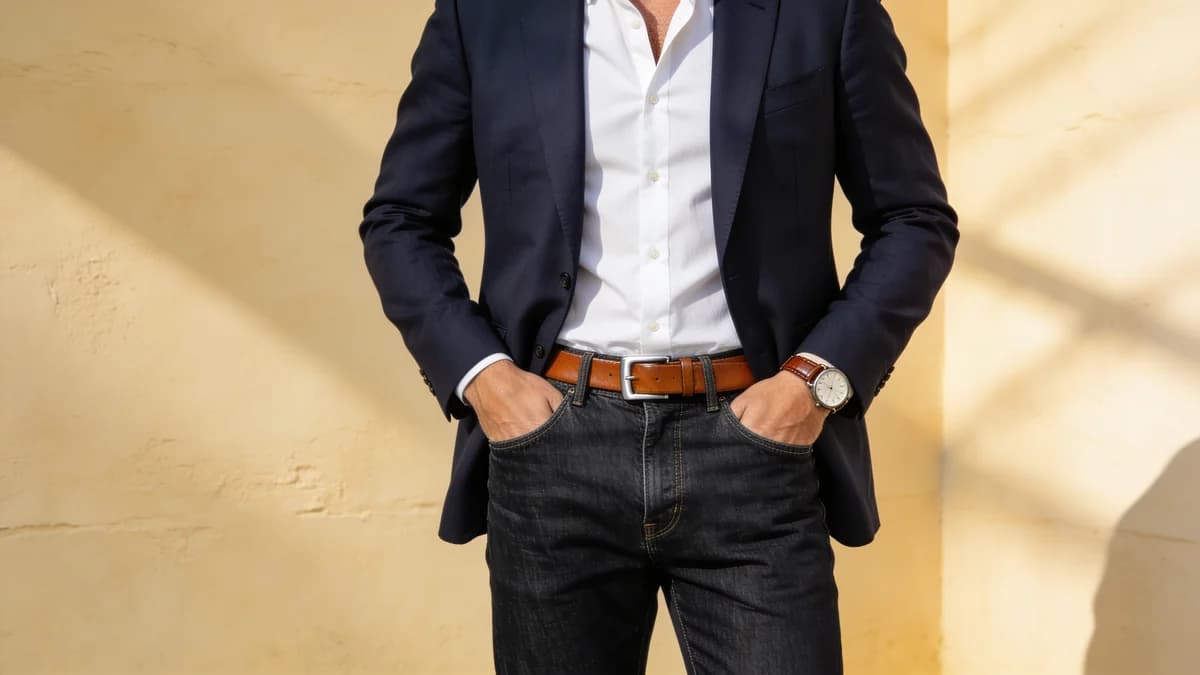
Dressing Better Is Seven Small Decisions, Not a New Wardrobe
The guy in the friend's photo who looks sharper than everyone else didn't spend more money. He made seven small decisions that compound. The framework: Fit, Fabric, Fit again. Fit comes first (Step 1), quality fabric builds on it (Steps 2 to 4), and tailoring closes whatever gap remains (Step 5). Below: each step with real brand examples (J.Crew, Suitsupply, Common Projects), the color strategy that works on most skin tones, and the pitfalls that quietly undo good outfits.
Step 1: Fix the Fit Before Anything Else
Most men buy clothes that don't fit because they shop the same way they have since they were teenagers: grab the size on the tag, pay, leave. Fit never enters the equation. And then the clothes hang in the closet unworn because they never looked quite right.
Fit is the single biggest variable in how clothes read on your body. Not brand, not price, not color. Fit.
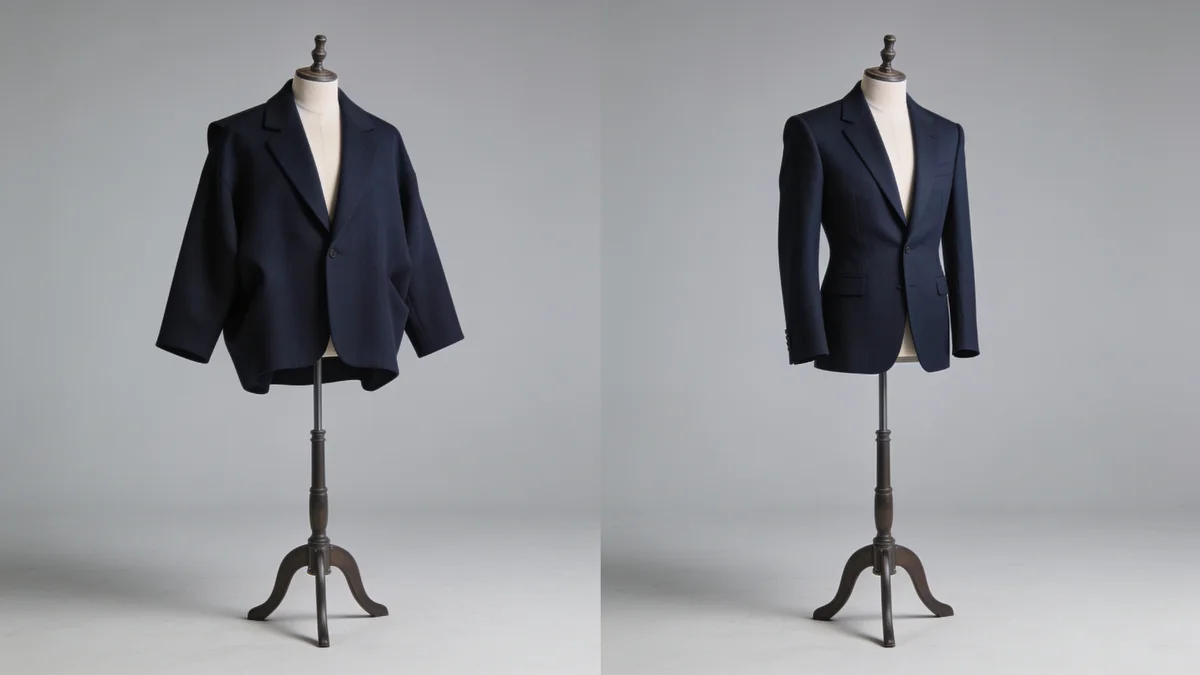
There are four checkpoints worth knowing by feel. The shoulder seam should land exactly where your shoulder bone ends, not an inch or two past it. When it falls past the edge, the whole torso reads baggy even if the rest of the shirt fits fine.
The sleeve length on a casual shirt or t-shirt should hit just above the base of your thumb when your arms hang naturally. Longer than that and it looks borrowed. For a jacket or sport coat, the hem should cover the curve of your seat but not extend further toward mid-thigh, which ages the silhouette considerably.
Trousers have their own rule: a full break at the ankle means there's too much fabric pooling over your shoe. No break at all pushes toward cropped territory that only works with specific shoes. The half break, where the front crease just grazes the top of your shoe, is the most versatile length for most men.
None of this is complicated. But it requires actually trying clothes on, which most men skip in favor of ordering online in their assumed size and keeping whatever arrives.
Here's something that clarifies why off-the-rack fitting is hard: try the same labeled "M" from three different brands. You'll get three genuinely different fits, because brands grade to different body assumptions. The size is not the measurement.
The fit is the measurement. Once you accept that and start trying before buying, every purchase hits differently.
Pro tip: a $40 tailored tee outperforms a $200 untailored one every time, because fit reads louder than price on every body.
Step 2: The 6 Foundation Pieces That Cover 80% of Occasions
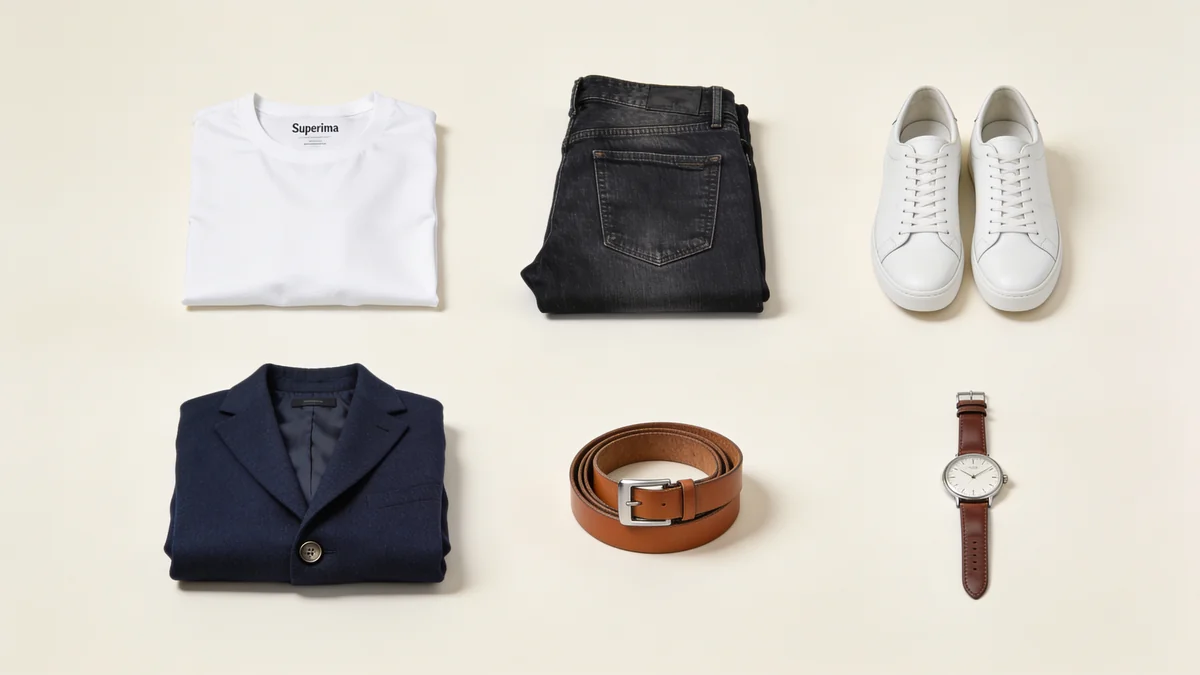
There's a version of the Pareto principle that applies directly to wardrobes: roughly 20 percent of your clothes create 80 percent of your best outfits. For most men, that 20 percent is six specific pieces, and building around them first eliminates the daily frustration of standing in front of a full closet with nothing to wear. If you want to take this further, the capsule wardrobe guide covers how to extend the same logic across seasons.
-
Plain white tee in Supima or pima cotton. Not a boxy fruit-of-the-loom undershirt, and not a skin-tight fashion tee. A fitted crew neck that sits at the natural waist, with a ribbed collar that holds its shape after washing. Sunspel makes the benchmark version. Uniqlo's Supima is the honest budget answer. Buck Mason sits comfortably in between.
-
Dark straight-leg jeans in a 10 to 12 oz denim, dark wash with no fading. Raw denim reads more formal than washed. A straight leg works across more shoe types than slim or wide. A.P.C. Petit Standard is the reference point. Naked & Famous makes excellent raw denim for less. Levi's 511 in a dark rinse is the widely available starting point that most people already own.
-
White leather sneakers, clean and minimal. Leather ages better than canvas, cleans easier, and reads a grade more formal. Common Projects Achilles is the gold standard. Greats Royale is the honest alternative at half the price. Veja Esplar adds sustainability credentials without sacrificing the look.
-
Navy unstructured blazer in cotton or lightweight wool. The word "unstructured" matters here. Padded, structured blazers belong with suits. An unstructured blazer drapes like a shirt and can be thrown over a tee without looking like you raided the office wardrobe. J.Crew Ludlow unstructured, Spier & Mackay, and SuitSupply all do this well under $250.
-
Brown leather belt, 1.25 inch width, that matches your shoes. This sounds minor until you wear a black belt with brown shoes once and someone notices. Allen Edmonds, Saddleback, and Anson Belt (the latter has a no-hole ratchet system that solves the between-sizes problem) are the three worth knowing.
-
One watch with a leather strap, simple face, under 40mm dial diameter. Not a smartwatch for this purpose. A clean analog face reads differently. Hamilton Khaki Field for those who want something serious under $500. Timex Weekender for under $50, which still looks right. Daniel Wellington Petite for a slimmer, dressier option.
I bought a $40 tee from Uniqlo Supima last year and replaced four nicer-brand tees that fit worse. The fit difference was immediate. The others went to donation.
Step 3: Color Strategy, 3 Neutrals Plus 1 Accent
Most beginner mistakes happen at color, not silhouette. A well-fitted outfit in clashing colors reads worse than a loosely fitted one in a clean palette. Color is where effort either shows or unravels.
The 3+1 rule is this: choose three neutrals that form the backbone of your wardrobe, then add one accent color that works with all three. Every piece you own should be in one of those four buckets. When everything pairs with everything else, getting dressed becomes fast and consistent.
The right neutrals and accents shift with skin tone:
| Skin tone | Best neutrals | Accent picks |
|---|---|---|
| Cool / fair | White, navy, charcoal | Burgundy, forest green, deep blue |
| Warm / olive | Cream, tan, olive | Mustard, terracotta, deep orange |
| Deep / dark | Off-white, camel, espresso | Bright cobalt, saffron, deep red |
Every piece must pair with every other piece in your palette. Buy only within your palette until the foundation is solid, then introduce patterns and statement pieces slowly.
Step 4: Shoes Set the Tone for Everything Else
You wear the same shoes every day. They're the part of the outfit closest to the ground, which means they're in almost every photo, every glance, every first impression. Shoes are also the piece men most commonly neglect.
Here's a scenario-based way to see why they matter this much. Whether you're going for a smart casual look or keeping it fully casual, the shoes read first. You're at a coffee shop on a Saturday in a plain tee and dark jeans.
Your shoes are scuffed grey canvas sneakers with yellowed soles. The outfit reads: this is what I threw on. Swap in clean white leather sneakers, same tee, same jeans.
The perception jumps two levels. Nothing else changed.
Now a smart casual office setting. Chinos, a button-down, untucked. Two shoe choices: beat-up brown loafers with cracked leather, or the same loafers freshly polished.
The polished pair carries the whole outfit. The beat-up pair makes the chinos look like they need washing even if they don't. The clothes are identical.
Dinner with someone new. Dark jeans, a fitted shirt. Sneakers versus brown Chelsea boots.
The Chelsea boot doesn't just look better, it signals that you thought about the outfit past the waist. That signal registers, even if the other person couldn't articulate why.
If budget is tight, own three pairs and rotate: white leather sneakers for casual, brown leather casual shoes (a loafer or clean derby) for smart casual, and one brown or black dress option for occasions that call for it. Three pairs done right will serve you further than eight pairs done carelessly.
Step 5: Tailoring Is the Cheat Code
Off-the-rack clothing is made to fit a statistical average. If your proportions fall outside that average in any dimension, and most people do in at least one, the clothes won't fit the way they should. Tailoring solves that problem at a fraction of what most men assume it costs.
A $60 shirt tailored to your body looks better than a $200 shirt off-the-rack. This is not hyperbole. It's geometry. The shape of the cloth relative to the shape of your torso determines everything, and a tailor adjusts that shape.
The four most common alterations worth knowing:
| Alteration | What it fixes | Approx cost (US) |
|---|---|---|
| Trouser hem | Right break length | $12-20 |
| Shirt side seam | Boxy fit becomes fitted | $20-35 |
| Sleeve shorten | Jacket sleeve length | $25-40 |
| Jacket waist taper | Boxy jacket fits the torso | $40-65 |
A trouser hem is the most common and least expensive fix. Most department stores now offer in-house alterations at the point of purchase. If they don't, independent tailors are everywhere.
Find one near you before you need one. Most basic alterations take 10 minutes to drop off and a few days to collect. The "Fit again" part of the framework pays off here: even a great fabric choice reads badly in the wrong shape.
Pro tip: never take a piece to a tailor unless you have worn it at least once and confirmed the fit issue is real, not just nerves about a new purchase.
Step 6: Add One Element of Contrast
An outfit needs one thing that contrasts with the rest to feel like it was assembled rather than grabbed. Without contrast, even well-fitted clothes in good colors can read flat. Too much contrast and the outfit tips into costume territory.
One element is the right amount.
Texture contrast is the easiest to get right. A smooth oxford cloth button-down under a textured tweed or linen sport coat gives the eye somewhere to land. Both items can be neutral in color.
The contrast is in the surface, not the palette. This works for everything from smart casual office outfits to dinner settings.
Color contrast works when everything else in the outfit is neutral. Navy trousers, a white shirt, and then one warm accent: a cognac leather belt, a cream knit, a caramel watch strap. The warm note against the cool neutrals creates the kind of look that reads as deliberate without drawing attention to itself.
Silhouette contrast is more advanced but worth understanding. A relaxed, slightly wide-leg trouser pairs with a slim fitted top. A boxy overshirt pairs with slim trousers.
The contrast between loose and fitted creates visual interest that monochromatic slim or monochromatic relaxed doesn't achieve on its own.
One element. Not three.
Step 7: Grooming, Posture, and the Small Details That Compound
Clothes are the canvas. You are the picture. Everything in the previous six steps works better when the person wearing it is maintaining themselves at the same standard.
Hair shape matters more than length. Whether you keep it short or longer, the shape needs a trim every four to six weeks. Hair that has grown past its intended shape reads as neglected regardless of the outfit underneath it.
A beard in transition, the three-to-five day scruff that isn't a beard yet and isn't a clean shave either, undercuts almost any outfit. Either maintain a beard with a defined edge or shave clean. The in-between reads as oversight.
Posture is entirely free and raises how any outfit reads by a significant margin. Shoulders back, head level. It's not complicated, it just requires remembering. An expensive jacket slouched forward looks worse than a cheap one worn upright.
Iron the collar of your shirt even if you skip the rest of the body. The collar frames your face. A crisp collar with a slightly wrinkled body reads as mostly sharp.
A wrinkled collar with a crisp body still reads as wrinkled. Five minutes, collar and front placket only.
Clean fingernails are noticed. So are bitten ones. This is a five-minute fix.
One fragrance, worn lightly. Not two layered on top of each other, not one applied heavily. A subtle signature scent is noticed in the best way.
Everything else is noticed in the other way.
None of these steps cost money. They cost attention.
Pro tip: build a 30-second mirror check into your routine before you leave. Collar, shoes, one hand through the hair. That sequence catches 90 percent of the things other people notice first.
Common Pitfalls That Undo All the Work
-
Wearing a tie with the wrong collar. A wide spread collar needs a Windsor knot. A narrow point collar suits a four-in-hand. Mismatching the collar spread to the knot size makes a well-chosen tie look awkward. Check the sport coat vs blazer vs suit jacket guide if you're navigating jacket formality alongside this.
-
Sneakers with a suit in most contexts. The combination works in editorial photography and occasionally in very specific creative industry settings. In 2026, it still reads as a mistake in most real-world contexts: job interviews, client meetings, weddings, funerals. Review the what to wear to an interview guide for where that line sits.
-
Belt color not matching shoe color. Black shoes, black belt. Brown shoes, brown belt. Tan shoes, tan or cognac belt. This is not a rigid rule in all contexts, but breaking it requires knowing why you're breaking it, not accidentally doing so.
-
Wrinkled clothes worn as if they're not. Ironing is not optional for shirts, trousers, or blazers. Five minutes with a steam iron before you leave prevents an impression that takes much longer to correct. A handheld steamer costs under $30 and handles travel wrinkles in under two minutes.
-
Buying for the man you want to be, not the life you actually live. A full suit purchased for a life that includes zero suit occasions will hang unworn for two years. A great pair of dark jeans, a fitted shirt, and clean leather shoes covers 90 percent of real occasions for most men. Build the wardrobe around your actual schedule, not a fantasy version of it.
Standing in front of the mirror before you leave doesn't have to involve any anxiety. Once the fit is right, the foundation pieces are in rotation, the palette is consistent, and the shoes are clean, the daily decision is simple. You're not starting from zero every morning.
You're editing from a solid baseline.
No stylist required. No major budget overhaul. Just seven decisions, made deliberately and repeated.
If you want to test combinations from clothes you already own before buying anything new, try Klodsy to build and visualize outfits from your existing wardrobe.
Related Articles
How to Wear a Polo Shirt (Men's Guide)
How to wear a polo shirt the right way. Fit, tuck rules, what to pair it with, and what to wear over it, so a polo reads smart casual instead of sloppy.
What Not to Wear in 2026: 15 Style Mistakes to Avoid
What not to wear in 2026: fit traps, color clashes, dated trends, occasion mismatches, and care mistakes that quietly ruin good outfits.
Men's Wear Guide: Building a Complete Men's Wardrobe
Complete men's wear guide: Build a versatile men's wardrobe. Learn about essential pieces, style principles, color coordination, and how AI can help you create perfect men's outfits.
Frequently Asked Questions
Everything you need to know about this topic
Fix the fit. A $40 t-shirt that hugs your shoulders properly beats a $200 tee that pulls or sags. Most fit problems come from the shoulder seam being too wide or the sleeve hitting the wrong spot. Try clothes on, do not assume sizes.