
Sport Coat vs Blazer vs Suit Jacket: Complete Guide
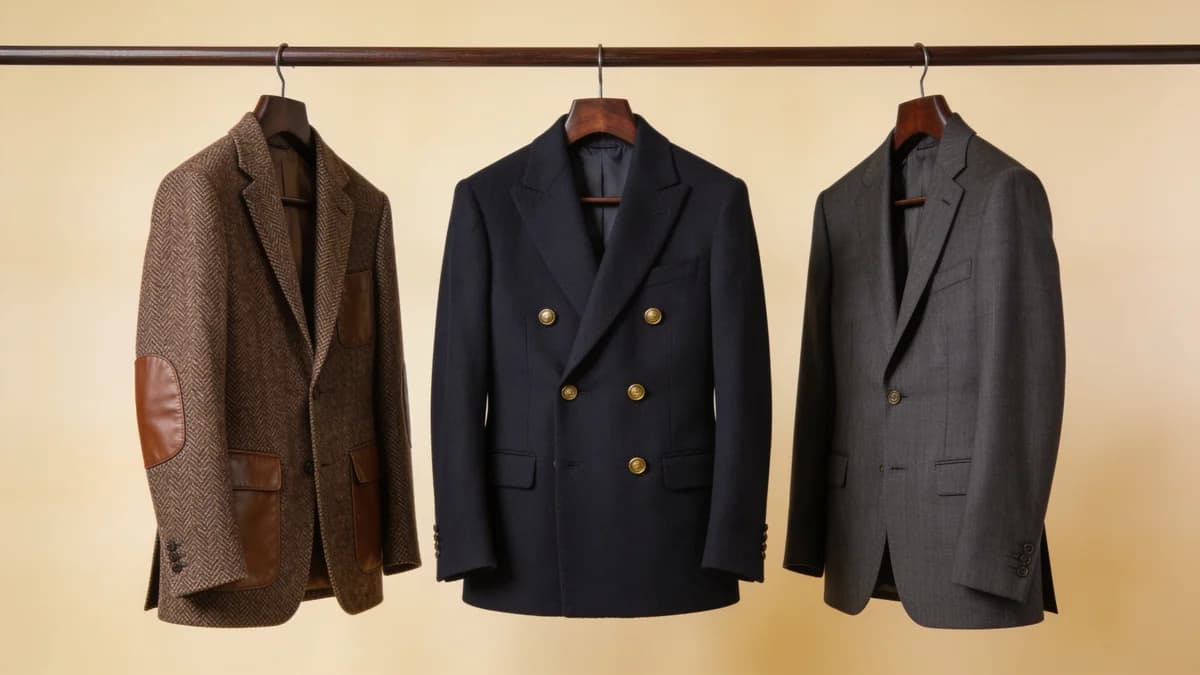
Sport Coat vs Blazer vs Suit Jacket: The 30-Second Decision
Three jackets in the closet, three different occasions. Check three things to know what you're holding before you read the label: Fabric (textured = sport coat, smooth = blazer or suit jacket), Buttons (brass = blazer, horn = suit jacket), Pairing (does it need its matching trousers? Yes = suit jacket only). That sequence beats every label. Below: a side-by-side comparison, when to wear each, fit rules for all three, and three pairings worth memorizing.
TL;DR: At a Glance
| Sport Coat | Blazer | Suit Jacket | |
|---|---|---|---|
| Formality | Casual to smart casual | Smart casual to business casual | Business formal to black tie |
| Fabric | Textured (tweed, herringbone, linen) | Smooth wool, solid color | Fine worsted wool, matching trousers |
| Pair with | Jeans, chinos, contrasting trousers | Chinos, dark jeans, wool trousers | ONLY its matching trousers |
| Worn alone? | Always | Always | Almost never |
Sport Coat: The Most Casual of the Three
The sport coat has a practical origin. In the English countryside during the late nineteenth century, men needed a jacket they could actually move in while shooting, fishing, or riding. It didn't have to match trousers.
It had to survive fields and weather. That utilitarian beginning is why, around 1900, the hunting jacket evolved into what we now recognize as the sport coat: a standalone jacket designed to live without a matching pant.
Fabric is what you notice first. Sport coats lean into texture. Herringbone and houndstooth are the classics.
Tweed, which has roots in the Scottish textile tradition going back to the 1830s, remains one of the best sport coat fabrics for autumn and winter. For summer sport coats, linen and cotton blends give you breathability without looking like you wandered in from a garden party.
Two or three buttons, patch pockets on the chest and hips, and a slightly relaxed cut are all normal. The patch pockets are a useful signal: they signal informality by design. A suit jacket never has them.
For smart casual outfit ideas, a sport coat with the right trousers often outperforms both a blazer and a full suit.
Pro tip: If you are buying a sport coat to wear over knitwear, go one size up. Knitwear under a jacket adds roughly an inch across the chest and back, and a sport coat that fits perfectly over a shirt will pull and gap once you add a chunky roll-neck or heavy-gauge sweater.
Five sport coat pairings that work:
- Charcoal herringbone sport coat + dark navy chinos + tan suede boots
- Brown tweed + gray flannel trousers + brown brogues
- Navy linen sport coat + white chinos + loafers (summer)
- Olive cotton sport coat + dark denim + white OCBD shirt
- Green check sport coat + tan chinos + burgundy loafers
Blazer: The Middle Ground That Works Almost Anywhere
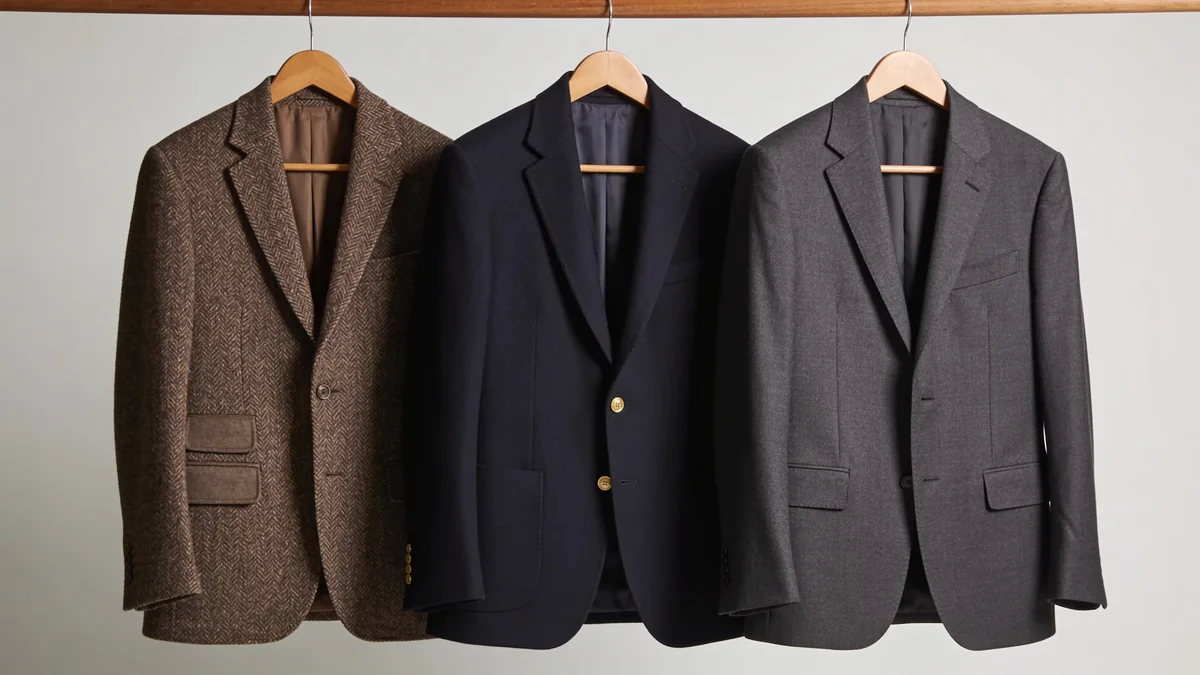
The blazer's origin story is better documented than the sport coat's. In 1837, the HMS Blazer was inspected by Queen Victoria, and the ship's captain reportedly outfitted his crew in bright navy double-breasted jackets to make a good impression. Whether the story is completely accurate or not, the navy blazer with brass-tone buttons became a real uniform piece, and that nautical DNA stayed in the garment.
A blazer is almost always solid in color, most often navy, and uses a smooth wool or wool-blend fabric without the texture you see in a sport coat. That smooth surface is what lets it clean up for business casual while still working with dark jeans on a Saturday. It sits exactly between the sport coat and the suit jacket on the formality scale, which is why it gets so much use.
I've worn the same navy blazer to five different cities this year: chinos to a client dinner, dark jeans for an evening out, gray wool trousers to a conference. One jacket, three contexts.
"If you only own one jacket, make it a navy blazer."
That advice, which appears in various forms across Permanent Style and the Esquire Big Black Book, is sound precisely because the blazer's versatility is real rather than theoretical. Simon Crompton of Permanent Style has written extensively about how a well-cut navy blazer outperforms specialty pieces in a working wardrobe.
Three blazers worth owning at some point:
- Navy smooth wool blazer, two buttons, notch lapel (the universal workhorse)
- Charcoal or mid-gray blazer (the navy blazer's cooler, slightly more formal sibling)
- A lighter casual option, linen or cotton, for warmer months and smart casual vs business casual situations
Suit Jacket: The Formal Sibling You Don't Wear Alone
Pick up a suit jacket and a sport coat and compare them. The suit jacket fabric is finer, smoother, and lighter in a specific way that signals precision rather than texture. Fine worsted wool is the standard.
The construction is more structured at the shoulder, the buttons are typically horn rather than brass, and the pockets are besom style, meaning they're slit pockets with a welted edge rather than patch or flap pockets.
All of that construction is designed to work with one specific thing: its matching trousers.
Suit fabrics are cut and dyed in a single run, so the jacket and trousers age together, fade together, and move together. Take the jacket off that system and pair it with random chinos, and the color won't quite match anything, the drape won't sit right with different-weight trousers, and the overall impression is of something incomplete. The Savile Row tailoring tradition has always treated the suit as a single garment that happens to come in two parts, not two separates that coordinate.
Pro tip: A suit jacket worn without its matching trousers almost always looks worse than wearing no jacket at all. The orphaned jacket signals something went wrong with the outfit rather than signaling intention. Save it for its own matching trousers.
That's the rule: if you want to wear just a jacket, reach for a blazer or sport coat. The suit jacket earns its keep at weddings, formal interviews, and events where the dress code asks for something close to black tie.
Suit jacket fabric weights by season:
| Season | Weight | Example Fabrics |
|---|---|---|
| Summer | 7-9 oz | Fresco, tropical wool, hopsack |
| All-season | 9-11 oz | Medium worsted, flannel blends |
| Winter | 12 oz+ | Heavy flannel, tweed suit weights |
The Decision Chooser: What to Wear When
It's a Saturday afternoon wedding in October, outdoor ceremony, dinner reception inside. The invitation says "semi-formal." If you have a suit, wear the full jacket with its matching trousers. If not, a navy blazer with gray wool trousers reads as appropriately dressed.
A sport coat would be underdressed here.
You're meeting your partner's parents for the first time at a nice restaurant. This is a blazer situation. A navy or charcoal blazer with dark jeans and a button-down signals effort without looking like a job interview.
A sport coat might read too casual depending on the restaurant.
Your cousin's wedding invitation says "cocktail attire." That means suit jacket with its matching trousers, full stop. A blazer sits a step below cocktail. See the full breakdown in our formal outfit ideas and dress code guide.
It's Monday at a creative agency with a smart casual policy. A sport coat in cotton or a subtle check works well. Pair with chinos or dark trousers, skip the tie.
A wine bar date in spring. Light blazer or a linen sport coat, light-colored trousers, no tie. The jacket signals intention without making the evening feel formal.
Fit Rules That Apply to All Three
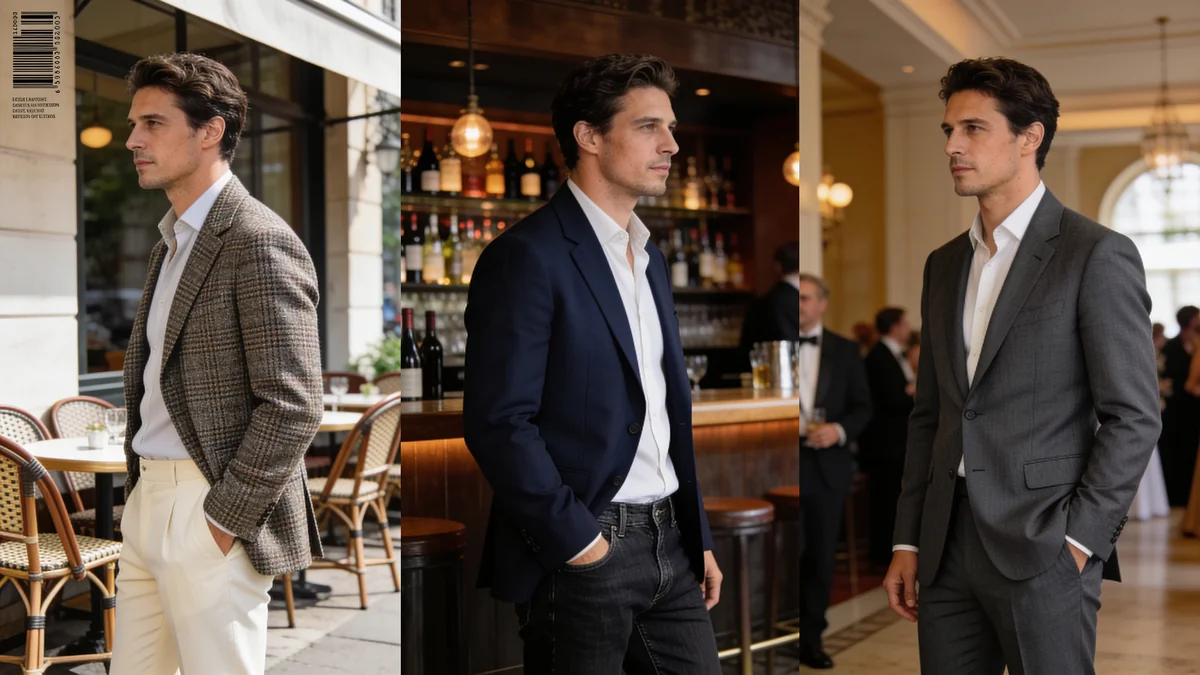
Fabric and formality matter, but fit is where all three jacket types succeed or fail. These checkpoints apply whether you're wearing a tweed sport coat or a fine suit jacket.
-
Shoulder seam sits exactly at the shoulder point. This is the most important and hardest point to alter. If it rolls onto your upper arm or sits toward your neck, the jacket doesn't fit. Roughly 90% of off-the-rack fit problems start here, and moving a shoulder seam means rebuilding the jacket.
-
Sleeve length shows a quarter to half inch of shirt cuff. Sleeves too long is the most common off-the-rack issue and the easiest fix. A sleeve shortening is inexpensive, and 10 minutes with a tailor is enough to get this right. The Savile Row tradition is consistent: shirt cuff should show, regardless of formality level.
-
Jacket length ends near the knuckle of your thumb. A rough guide rather than an absolute, but it keeps you away from jackets that are visibly too short or too long for your frame.
-
Button stance and lapel width should suit your proportions. A longer torso reads better with a slightly lower button stance. The Esquire Big Black Book has covered this ratio principle across multiple editions.
-
The back lies flat without pulling or bunching. Pulling across the shoulder blades means it's too small in the chest. Bunching at the waist means it's too large. Both signal the wrong size, not something a tailor can fix.
Common Mistakes
Wearing a suit jacket alone with jeans is the most common jacket error. Suit jackets look similar to blazers at a glance, but the fabric quality and orphaned feeling give it away. Get a real blazer if you want that casual-dressed-up effect.
Ignoring fabric weight by season is less obvious but real. A heavy tweed sport coat at a July outdoor event is uncomfortable and it shows. Summer calls for linen, cotton, or tropical wool.
Autumn and winter reward heavier fabrics because they drape better in cold air.
Buying off-the-rack without any tailoring. The two most common fixes, sleeve length and taking in the waist, cost very little and transform how a jacket sits. Brooks Brothers, in the tailored clothing business since 1818, has always included alterations with suit purchases for exactly this reason.
For everyday menswear combinations, avoid pairing a black blazer with light chinos or pale shirts. The contrast reads unresolved. Navy and charcoal pair more naturally across a wider range of casual and smart casual looks.
Three Pairings Worth Memorizing
Each pairing below passes the Fabric, Buttons, Pairing check. The fabric fits the occasion, the buttons signal the right formality, and the trouser choice is deliberate rather than default.
Navy blazer + gray chinos + brown leather loafers. This is the most reliable smart casual combination in the blazer vs jacket conversation. It works for business casual offices, client lunches, and almost any event that doesn't require a full suit. The brown shoe against navy jacket is a pairing that menswear writers have consistently recommended for decades.
Tweed sport coat + dark jeans + brown suede chukkas. The sport coat's natural habitat. Dark denim keeps the jeans from reading too casual, the suede adds texture that complements the tweed, and the chukka boot's ankle height balances the casual register of the whole outfit. This is a go-to for autumn weekends and casual evening events.
Charcoal suit jacket + matching charcoal trousers + black oxfords. When the suit jacket comes out, it comes out as a system. The matching trousers and the black Oxford shoe are the formal foundation that justifies the jacket's construction and weight. This works for formal occasions without requiring a tuxedo.
The right jacket for the moment is rarely the most expensive one in your closet. It's the one built for the occasion's formality level, made of fabric appropriate for the season, and actually fitted to your body. Once those three things line up, the sport coat vs blazer vs suit jacket question answers itself fairly quickly.
Try Klodsy to plan and visualize menswear outfits before you walk out the door.
Frequently Asked Questions
Everything you need to know about this topic
Sport coat: most casual, textured fabric, never matches pants. Blazer: middle ground, solid color (usually navy), can dress up or down. Suit jacket: most formal, matches its trousers, never worn casually with jeans.