
AI Color Analysis: Find Your Perfect Color Palette in 2026

The $4,300 Mistake Hiding in Your Closet: Why Color Analysis Matters
The average person owns 37 clothing items in colors that wash them out. At an average cost of $117 per item, that represents $4,329 of wasted wardrobe potential sitting in closets across America. The clothes fit fine. The styles are good. But the colors are wrong for the person wearing them.
Here is the uncomfortable truth: 78% of people regularly wear colors that make them look tired, older, or washed out. This is not subjective opinion. It is measurable science. When you wear colors that clash with your natural coloring, they create shadows where they should not exist, drain vibrancy from your skin, and make you look less healthy than you are.
Color analysis has existed since the 1980s when Carole Jackson published "Color Me Beautiful" and introduced the four-season system. The concept is simple: certain colors harmonize with your natural coloring (skin, eyes, hair) while others clash. The right colors make you look vibrant, healthy, and polished. The wrong colors drain the life from your face.
What AI color analysis delivers in 2026:
- Instant results from a single selfie
- Consistent, algorithm-driven analysis free from human bias
- Detailed palette with hex codes you can reference anywhere
- Integration with shopping and wardrobe apps
- Free or low-cost access that democratizes professional styling
"I spent $400 on professional color analysis in 2019. The AI app gave me the same season assignment and a more detailed palette in 30 seconds. I wish this technology existed five years ago." — Michelle T., Marketing Director
The Science Behind AI Color Analysis: How Algorithms See Your True Colors
AI color analysis is not guesswork dressed up as technology. It applies decades of color theory research through computer vision algorithms trained on hundreds of thousands of analyzed faces.
How AI Reads Your Natural Coloring
When you upload a selfie, AI examines three key attributes with remarkable precision:
Skin Undertone Detection: The AI analyzes pixel values across multiple facial zones:
- Cheekbones (least affected by sun exposure)
- Inner wrist area (if visible)
- Jawline (for shadow analysis)
- Forehead (for overall tone mapping)
It identifies whether underlying pigments lean warm (yellow/golden), cool (pink/blue), or neutral. Crucially, AI distinguishes between surface tone and undertone, something that confuses many humans attempting self-analysis.
Eye Color Mapping: Your iris contains information beyond basic color:
- Dominant color classification (brown, blue, green, hazel, gray)
- Secondary fleck identification (golden rays, cool gray, warm amber)
- Depth measurement (light, medium, deep)
- Warmth assessment of the eye color itself
Hair Color Analysis: The AI evaluates your natural hair color considering:
- Base tone warmth or coolness
- Depth from blonde to black
- Highlight and lowlight variation
- How hair color frames and affects facial appearance
The 12-Season Color System Decoded
Traditional four-season analysis (Spring, Summer, Autumn, Winter) has evolved into a 12-type system that provides more nuanced recommendations:
| Season | Primary Characteristic | Secondary Characteristic | Third Characteristic |
|---|---|---|---|
| Light Spring | Light + Warm | Clear features | Delicate coloring |
| True Spring | Warm dominant | Clear and bright | Medium depth |
| Bright Spring | Clear + Warm | High contrast | Vivid features |
| Light Summer | Light + Cool | Soft, muted | Low contrast |
| True Summer | Cool dominant | Soft features | Medium depth |
| Soft Summer | Muted + Cool | Blended tones | Low contrast |
| Soft Autumn | Muted + Warm | Soft, earthy | Low contrast |
| True Autumn | Warm dominant | Rich, earthy | Medium depth |
| Deep Autumn | Deep + Warm | Rich coloring | High depth |
| Deep Winter | Deep + Cool | High contrast | Bold features |
| True Winter | Cool dominant | Clear, bold | Medium-high contrast |
| Bright Winter | Clear + Cool | High contrast | Vivid features |
AI accuracy by season type (2026 benchmarks):
- Clear seasons (Bright Spring, Bright Winter): 94% accuracy
- Deep seasons (Deep Autumn, Deep Winter): 91% accuracy
- Soft seasons (Soft Summer, Soft Autumn): 87% accuracy
- Light seasons (Light Spring, Light Summer): 89% accuracy
- True seasons (all four): 92% accuracy
The slight variance in soft season accuracy reflects the subtlety of these types, which even professional colorists find challenging.
Getting Accurate AI Color Analysis Results: The Complete Photo Guide
The quality of your results depends entirely on the quality of your input. A poorly lit selfie will produce inaccurate results regardless of how sophisticated the AI is.
Phase 1: Preparing for Your Analysis Photo
The 24-Hour Preparation:
- Remove all makeup the night before (allows skin to normalize)
- Avoid facial treatments that cause redness
- Stay hydrated (dehydration affects skin appearance)
- Get adequate sleep (fatigue changes skin tone)
Environment Setup:
- Choose a room with a large window
- Remove colored curtains or blinds that might cast color onto your face
- Clear the immediate area of brightly colored objects
- Prepare a white or neutral gray background
Phase 2: Taking the Perfect Analysis Photo
Timing matters:
- Best: 10 AM to 2 PM on an overcast day
- Good: Morning or afternoon with indirect window light
- Avoid: Golden hour, direct sunlight, artificial lighting
Camera positioning:
- Use front-facing camera at arm's length
- Position phone at eye level (not from above or below)
- Ensure face fills 40-60% of the frame
- Center your face with even spacing on all sides
What to wear:
- White, off-white, or light gray top
- Nothing with patterns or bright colors near face
- Pull hair back from face and neck
- Remove all jewelry, especially near face
Checklist before capture:
- Natural daylight, no artificial lights on
- Neutral background (white, gray, or beige wall)
- Face clean, no makeup whatsoever
- Hair pulled back from face
- White or neutral top
- Relaxed, neutral expression
- No glasses (even clear ones can cast shadows)
- No filters or beauty mode
Phase 3: Submitting and Interpreting Results
What AI analysis typically provides:
- Your seasonal type (one of 12)
- Undertone classification (warm, cool, neutral)
- Personal color palette (30-60 specific colors)
- Best and worst colors list
- Metal recommendations (gold, silver, rose gold)
Understanding your palette: Your generated palette will include:
- Neutrals (5-8 colors): Your base wardrobe colors
- Core colors (10-15 colors): Everyday flattering shades
- Accent colors (8-12 colors): Statement pieces and accessories
- Avoid list (10-20 colors): Colors that clash with your coloring
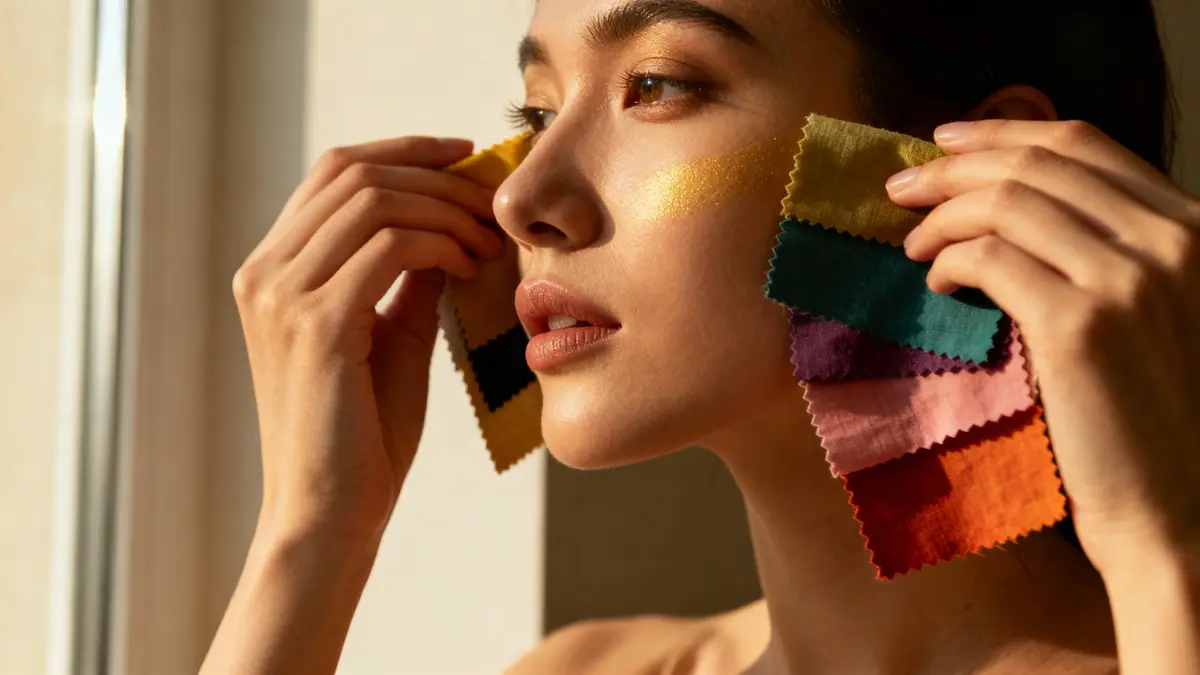
Color Analysis by Season: What Each Type Should Wear
Warm Seasons: Spring and Autumn Types
Light Spring Characteristics: Natural features: Light blonde or light brown hair, blue or green eyes, fair skin with golden undertone
- Best colors: Peach, coral, warm pink, light aqua, golden yellow
- Avoid: Black, burgundy, dark navy, cool gray
True Spring Characteristics: Natural features: Golden blonde to medium brown hair, warm-colored eyes, skin with golden glow
- Best colors: Bright coral, turquoise, warm red, golden brown, grass green
- Avoid: Black, cool pink, burgundy, pure white
Bright Spring Characteristics: Natural features: Clear contrast between hair and skin, bright eyes, warm but clear coloring
- Best colors: Hot pink, bright turquoise, orange-red, electric blue, lime green
- Avoid: Muted tones, dusty colors, dark brown, beige
Soft Autumn Characteristics: Natural features: Ash brown or soft auburn hair, muted eye color, low contrast coloring
- Best colors: Soft teal, dusty rose, sage green, camel, soft coral
- Avoid: Black, bright white, neon colors, cool pastels
True Autumn Characteristics: Natural features: Red, auburn, or warm brown hair, warm hazel or brown eyes, golden skin
- Best colors: Rust, olive green, burnt orange, mustard, chocolate brown
- Avoid: Pure white, black, cool pink, electric blue
Deep Autumn Characteristics: Natural features: Dark brown or black hair with warm undertone, dark brown eyes, rich coloring
- Best colors: Forest green, burgundy, deep teal, bronze, warm chocolate
- Avoid: Pastels, icy colors, pure white, light gray
Cool Seasons: Summer and Winter Types
Light Summer Characteristics: Natural features: Ash blonde or light brown hair, blue-gray or soft green eyes, pink undertone skin
- Best colors: Powder blue, soft pink, lavender, mauve, light gray
- Avoid: Orange, golden yellow, bright white, warm brown
True Summer Characteristics: Natural features: Ash brown hair, blue or cool green eyes, pink or neutral undertone
- Best colors: Rose pink, blue-gray, soft navy, raspberry, sage
- Avoid: Orange, tomato red, mustard, warm brown
Soft Summer Characteristics: Natural features: Ash hair color, muted eyes, low contrast, cool but soft coloring
- Best colors: Dusty blue, soft mauve, pewter, cocoa, slate
- Avoid: Black, bright colors, orange, golden yellow
Deep Winter Characteristics: Natural features: Dark hair, dark eyes, high contrast, cool undertone
- Best colors: Black, pure white, burgundy, emerald, royal blue
- Avoid: Muted colors, beige, orange, golden brown
True Winter Characteristics: Natural features: Dark hair with cool sheen, cool-colored eyes, clear skin tone
- Best colors: Pure white, black, hot pink, royal purple, true red
- Avoid: Warm colors, muted tones, orange, gold
Bright Winter Characteristics: Natural features: High contrast coloring, bright eyes, clear skin with cool undertone
- Best colors: Fuchsia, electric blue, emerald, lemon yellow, true red
- Avoid: Muted colors, dusty shades, warm earth tones
Applying Your Color Palette: The Practical Wardrobe Strategy
Knowing your colors is only valuable if you use them. Here is how to translate AI color analysis into a functional wardrobe strategy.
The Palette Integration Framework
Step 1: Wardrobe Audit by Color Go through every item in your closet and categorize:
- A-List: Colors in your palette (keep and wear prominently)
- B-List: Neutral or near-palette colors (keep for layering)
- C-List: Off-palette colors you love (keep for strategic use)
- D-List: Off-palette colors with no emotional attachment (donate)
Step 2: Strategic Color Placement Where you place colors matters:
- Near face: Only A-List palette colors
- Bottoms: A-List or B-List colors
- Accessories: Can include C-List colors
- Outerwear: A-List or B-List colors
Step 3: Building the Foundation
| Category | Palette Approach |
|---|---|
| Base layer (t-shirts, tanks) | Your best neutrals from palette |
| Bottoms | Dark neutrals from palette |
| Outer layers | Neutrals or accent colors |
| Statement pieces | Accent colors from palette |
| Accessories | Accent colors, metal recommendations |
The 80/20 Color Rule
Aim for this distribution in your wardrobe:
- 80% palette colors: Creates cohesion and ensures everything works
- 20% strategic off-palette: Allows for trends and personal expression
Off-palette wearing strategies:
- Use off-palette colors below the waist only
- Create buffer between off-palette colors and your face
- Pair off-palette pieces with strong palette colors
- Limit off-palette to accessories rather than main garments
Color Combinations That Always Work
Monochromatic formula: Choose any color from your palette and wear varying shades:
- Light version as base
- Medium as main
- Dark as accent
Neutral + Accent formula: Select a neutral from your palette plus one accent:
- Neutral covers 80% of outfit
- Accent in one focal piece
Analogous formula: Choose 2-3 colors that sit next to each other on your palette:
- Creates sophisticated harmony
- Works particularly well for soft seasons
Beyond Clothing: Complete Color Analysis Application
Your color palette extends beyond wardrobe. Here is how to use AI color analysis across your entire appearance.
Makeup Colors by Season
Lip colors aligned to season:
| Season Type | Best Lip Shades | Avoid |
|---|---|---|
| Spring | Coral, peach, warm pink, clear red | Berry, burgundy, cool mauve |
| Summer | Rose, mauve, berry, cool pink | Orange, coral, warm red |
| Autumn | Rust, terracotta, warm berry, brown-pink | Hot pink, cool red, fuchsia |
| Winter | True red, berry, fuchsia, wine | Orange, peach, nude brown |
Eye shadow guidance:
- Warm seasons: Bronze, copper, warm brown, gold, olive
- Cool seasons: Taupe, plum, cool brown, silver, charcoal
Blush selection:
- Warm undertones: Peach, apricot, coral, warm pink
- Cool undertones: Rose, berry, cool pink, mauve
Hair Color Direction
Considering a color change? Your seasonal type suggests flattering directions:
Warm seasons (Spring, Autumn):
- Go warmer: golden highlights, caramel, auburn, copper
- Avoid: Ash tones, platinum, blue-black
Cool seasons (Summer, Winter):
- Go cooler: ash tones, cool brown, burgundy, platinum
- Avoid: Golden highlights, brassy tones, orange-red
Depth considerations:
- Light seasons: Stay within 2-3 shades of natural
- Deep seasons: Can go very dark or maintain depth
- Soft seasons: Avoid dramatic contrast changes
- Clear seasons: Can handle more dramatic changes
Jewelry and Accessories
Metal recommendations by undertone:
| Undertone | Best Metals | Secondary | Avoid |
|---|---|---|---|
| Warm | Gold, rose gold, brass, copper | Bronze, antique gold | Silver, platinum, white gold |
| Cool | Silver, platinum, white gold | Rose gold (subtle) | Yellow gold, brass |
| Neutral | Rose gold, mixed metals | Both gold and silver | None specifically |
Accessory color strategy: Your accent colors are perfect for:
- Scarves and wraps
- Handbags
- Statement jewelry
- Shoes
- Belts
- Hats
Common Color Analysis Mistakes and Misconceptions
Understanding what AI color analysis cannot do is as important as knowing what it can.
Mistake 1: Expecting One-Size-Fits-All Results
The myth: AI gives you a definitive list of exact colors you must wear forever.
The reality: Your palette is a guide, not a prison. Lighting, personal preference, and context all matter. A True Summer can absolutely wear a coral dress to their best friend's beach wedding.
The solution: Treat your palette as a starting point. Test recommendations, note what works, and develop your own refined version over time.
Mistake 2: Ignoring Photo Quality Impact
The myth: AI is so smart it can analyze any photo accurately.
The reality: Garbage in, garbage out. A selfie with yellow bathroom lighting will make you appear warmer than you are. A photo near a blue wall will cool your apparent undertone.
The solution: Follow the photo guidelines precisely. If your results seem wrong, retake with better conditions before dismissing the technology.
Mistake 3: Confusing Surface Tone with Undertone
The myth: Your visible skin color determines your season.
The reality: A pale person can have warm undertones. A dark-skinned person can have cool undertones. Surface tone and undertone are independent characteristics.
The solution: Focus on how colors make you look, not on your skin's surface appearance. AI specifically analyzes undertone, which is why photo quality matters so much.
Mistake 4: Applying Seasonal Rules Too Rigidly
The myth: You must only wear your palette colors or you will look terrible.
The reality: Fashion is expression. Rules exist to serve you, not imprison you. Intentional rule-breaking can create powerful style statements.
The solution: Learn the rules so you can break them intelligently. Understand why certain colors work, then make informed decisions about when to deviate.
Mistake 5: Treating Analysis as One-Time Event
The myth: Your colors never change once determined.
The reality: Significant changes can shift your optimal palette:
- Going gray can move you to a cooler or softer season
- Tanning temporarily warms appearance
- Aging often softens contrast
- Hair color changes affect overall harmony
The solution: Reanalyze every 2-3 years or after major appearance changes. Your seasonal type rarely shifts dramatically, but your best specific shades may evolve.
The 21-Day Color Confidence Challenge
Transform your relationship with color in three weeks:
Week 1: Analysis and Audit (Days 1-7)
Day 1-2: Complete proper AI color analysis
- Take multiple photos under ideal conditions
- Run analysis on at least two apps to compare
- Record your season and save your palette
Day 3-4: Document your current wardrobe by color
- Photograph everything in good light
- Create categories based on palette alignment
- Note patterns (too much of one color, missing colors)
Day 5-7: Research and reference building
- Save your palette to phone for easy shopping reference
- Find style inspiration within your season
- Research celebrities with your coloring for ideas
Goal: Complete understanding of your current state
Week 2: Implementation (Days 8-14)
Day 8-10: Reorganize closet by palette alignment
- Move A-List items to prime real estate
- Group B-List items together
- Isolate C and D-List items for decisions
Day 11-12: Create 10 outfits using only palette colors
- Document with photos
- Note which combinations feel best
- Identify gaps in your palette coverage
Day 13-14: Test one strategic non-palette piece
- Wear a loved off-palette item
- Note how it photographs
- Compare feeling to full-palette outfits
Goal: Working palette-based wardrobe system
Week 3: Refinement (Days 15-21)
Day 15-17: Shop or plan shopping list
- Research pieces to fill palette gaps
- Return or donate D-List items
- Focus on versatile palette neutrals first
Day 18-19: Extend to beauty
- Test makeup shades aligned with your palette
- Note which new recommendations work
- Update beauty routine accordingly
Day 20-21: Full integration assessment
- Photograph yourself in palette vs. non-palette
- Document the differences
- Commit to 80/20 approach going forward
Expected results after 21 days:
- Clear understanding of your season and best colors
- Reorganized wardrobe with improved cohesion
- Shopping strategy that prevents color mistakes
- Makeup colors that enhance rather than clash
- Confidence in color choices
"Day 21 photo comparison was wild. Same person, same lighting, just different colors. The palette outfit made me look 5 years younger. Cannot unsee it now." — David L., Software Engineer
Advanced Color Strategy: Seasonal Crossover and Exceptions
When Season Lines Blur
Not everyone fits neatly into one category. Common crossover situations:
Spring-Autumn Crossover: If you test between these warm seasons, focus on:
- Clarity: Springs need clearer, brighter colors
- Depth: Autumns can go richer and deeper
- Both can share: Coral, warm teal, warm brown
Summer-Winter Crossover: If you test between these cool seasons, focus on:
- Contrast: Winters need more contrast
- Softness: Summers need muted versions
- Both can share: Navy, burgundy, cool gray
Neutral Undertone Navigation: True neutrals (rare, about 10% of population) can wear:
- Most colors from both warm and cool palettes
- Should focus on value (light/dark) and clarity (bright/muted)
- Best served by testing individual colors rather than applying season rules
Strategic Exception-Making
Times when off-palette colors make sense:
Professional contexts:
- Industry standard colors (navy suits, white shirts)
- Company brand colors in work wardrobe
- Interview-appropriate conservative colors
Cultural and social contexts:
- Wedding dress white regardless of season
- Cultural celebration colors
- Team or group coordination colors
Strategic attention-drawing:
- Presentation or stage appearance
- Networking events
- Job interviews where you want to stand out
Rule for exceptions: When wearing off-palette strategically, ensure your face is buffered by a palette color (scarf, collar, earrings).
Integrating Color Analysis with AI Wardrobe Tools
Color analysis becomes most powerful when connected to your daily outfit decisions.
How Klodsy Uses Your Color Data
When you combine color analysis with an AI wardrobe app:
- Wardrobe color tagging: Every uploaded item gets analyzed for palette compatibility
- Smart outfit filtering: Suggestions prioritize flattering color combinations
- Gap identification: AI notices when your wardrobe lacks key palette colors
- Shopping guidance: New item recommendations match your palette automatically
- Seasonal adjustments: Suggests how to adapt palette to weather and occasions
Building the Connected Color System
Step 1: Complete AI color analysis and save results
Step 2: Upload wardrobe to Klodsy with photos in good lighting
Step 3: Tag items by palette compatibility (app can assist with this)
Step 4: Enable color-aware outfit suggestions
Step 5: Let AI learn which specific palette colors you gravitate toward
Benefit: Your daily outfit suggestions are automatically limited to flattering combinations while maximizing wardrobe utilization.
The Bottom Line: Why Color Analysis Is Your Style Foundation
Color is the first thing people notice about your outfit, before they register style, fit, or brand. Getting color right creates an immediate positive impression. Getting it wrong creates visual dissonance that viewers sense even if they cannot articulate why.
What color awareness delivers:
- Looking healthier and more vibrant without any other changes
- Simplified shopping decisions (instant yes/no on new items)
- More cohesive wardrobe where everything works together
- Reduced waste from buying colors that end up unworn
- Increased confidence from visual harmony
The investment required:
- 30 minutes for proper AI color analysis
- 2-3 hours for initial wardrobe audit
- Ongoing attention to color in future purchases
The return:
- Every future outfit looks better
- Money saved on wrong-color purchases
- Time saved on outfit decision-making
- Compliments on how healthy/vibrant you look
Color analysis is not about restriction. It is about understanding what works so you can make informed choices. Some of the most stylish people intentionally break color rules, but they do so knowing what the rules are and why breaking them creates their intended effect.
Your palette is your starting point. What you build from there is entirely up to you.
Ready to discover your perfect color palette?
Start Your AI Color Analysis with Klodsy
Related Reading
- AI Wardrobe App 2026: Build Your Smart Digital Closet - Complete guide to digitizing your wardrobe
- Capsule Wardrobe AI Planner: Build a Minimalist Closet - Create a cohesive wardrobe with AI assistance
- How to Get Outfit Ideas from the Clothes You Already Own - Maximize your existing wardrobe
- AI Outfit Planner: Create Stylings With Your Own Clothes - Deep dive into AI outfit creation
Related Articles
AI Outfit Rating: Get Style Score and Feedback in 2026
Rate your outfits with AI. Learn how AI style scoring works, get honest feedback on your looks, and improve your fashion sense with data-driven outfit analysis.
AI-Powered Style: How AI Is Changing Fashion Forever
Discover how AI is revolutionizing personal style with smart outfit recommendations, virtual try-ons, and personalized fashion advice. The future of fashion is here.
Frequently Asked Questions
Everything you need to know about this topic
AI color analysis uses computer vision to scan your selfie, detecting skin undertone, eye color, and hair color. It then matches these attributes against color theory frameworks to identify your seasonal color type and recommend a personalized palette of flattering shades.